Immigration lawyer: What Fast-Track Court Fights Hide
Need an immigration lawyer after 2025 fast-track court fights? Learn what changed, what to do in 48 hours, and protect your case—call 1-844-967-3536.
Vasquez Law Firm
Published on December 24, 2025

Immigration lawyer: What Fast-Track Court Fights Hide
If you feel like immigration rules changed “overnight,” you’re not imagining it. The fast-track court fights shaping immigration litigation in 2025 are speeding up timelines, tightening evidence rules, and increasing the risk of a denial that’s hard to undo—especially for families and workers in North Carolina who are waiting on USCIS decisions, consular interviews, or immigration court hearings.
Quick Summary (Read This First)
What happened: In 2025, immigration cases are increasingly being shaped by fast-moving federal court battles over agency rules, enforcement actions, and emergency orders.
Why it matters to you: Faster litigation can quickly change eligibility, filing strategy, and timing for people living in North Carolina—sometimes while your case is pending.
What to do now: Preserve proof, confirm your current status and deadlines, and avoid “quick fixes” that could trigger removal or a permanent bar.
What This News Means for North Carolina Residents
Why “fast-track” litigation can hit your case mid-stream
According to coverage of how fast-track court fights shaped immigration litigation in 2025, major immigration questions are being argued and decided on accelerated timelines. That matters because the practical rules that control your case are often a mix of statutes, regulations, agency guidance, and court decisions.
When federal courts issue rapid orders—especially nationwide or multi-state decisions—USCIS processing, consular scheduling, and immigration court practice can shift quickly. People often learn about the shift only after getting a Request for Evidence (RFE), a Notice of Intent to Deny (NOID), or a sudden interview reschedule.
Where North Carolina families and workers feel it first
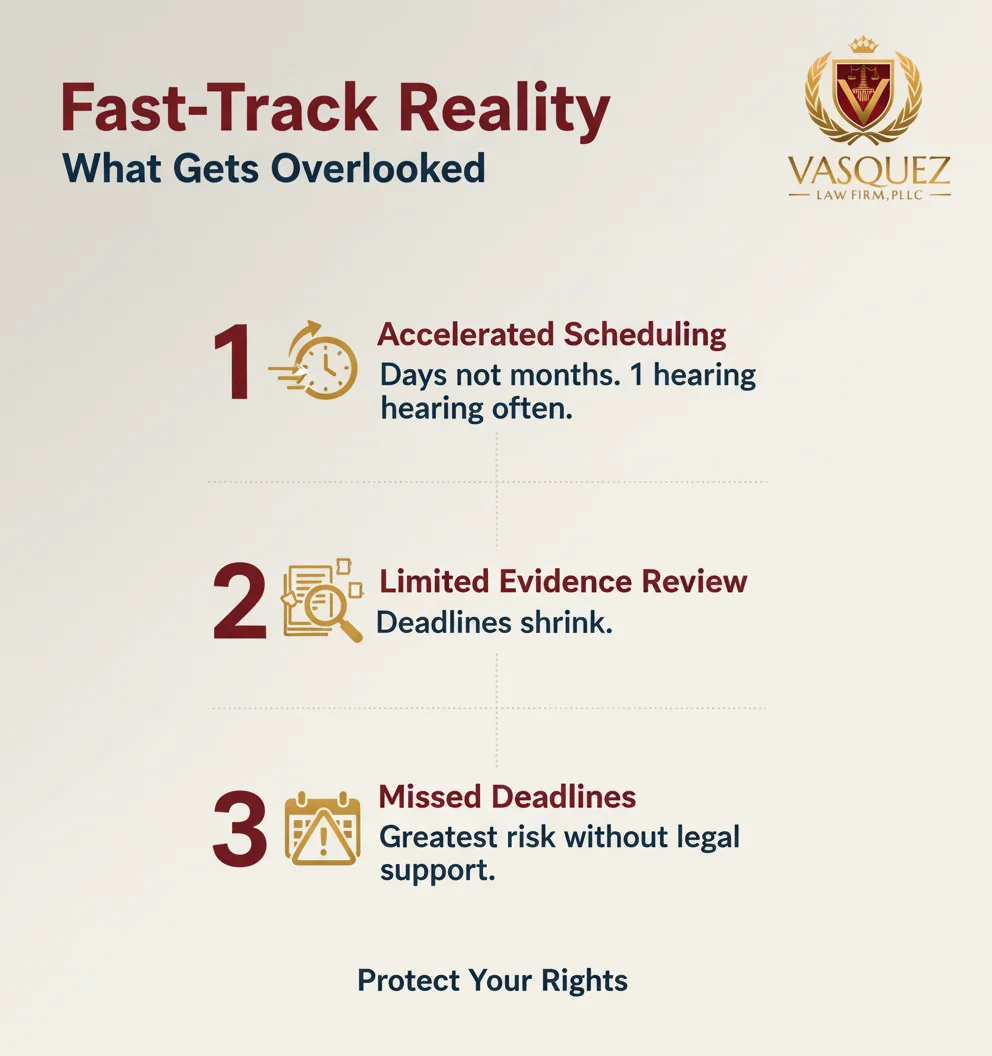
Serving North Carolina residents, we see “fast-track” effects show up in three common places: (1) delays that suddenly turn into short deadlines, (2) changing documentary expectations, and (3) increased denials when a case is filed with the wrong category or weak evidence.
If your matter touches the Charlotte Immigration Court (EOIR) or requires consular processing abroad, speed can create extra risk. A case that would have been corrected with a simple update months later might now be evaluated under a new standard before you can react.
What’s at stake if you guess wrong
Immigration is unforgiving. One missed deadline, one inconsistent statement, or one “helpful” form prepared incorrectly can trigger a denial, a referral to removal proceedings, or long-term consequences like unlawful presence bars. An immigration lawyer’s role is often less about “filling out forms” and more about risk control—choosing the safest strategy under moving legal targets.
What to Do in the Next 24-48 Hours
1) Freeze the record (before it changes)
Fast litigation and policy changes mean your “paper trail” matters more than ever. Capture what your case looked like today—receipts, notices, online status pages, and communications.
2) Confirm deadlines and where your case is pending
Deadlines differ depending on whether your case is with USCIS, a U.S. consulate, or immigration court. You also need to know whether any appeal clock is running.
3) Avoid self-inflicted problems
In a fast-shifting environment, “quick fixes” (travel, new filings, or withdrawing a case) can backfire. Do not assume last year’s advice still applies.
If this situation applies to you, take these steps NOW:
- Step 1: Screenshot and save your current case status, receipt notices, and any RFE/NOID letters; write down key dates (filing date, biometrics date, interview date).
- Step 2: Pull your full immigration history and identify urgent clocks (RFE response deadlines, EOIR hearing dates, appeal deadlines like BIA timing).
- Step 3: Do NOT file “duplicate” applications or new petitions to fix a delay without checking how it affects status, fees, and possible removal triggers.
- Step 4: Consult with a legal expert to understand your rights and options.
Warning Signs & Red Flags to Watch For
Red flags that your case is being decided under a new standard
Fast-track litigation often shows up indirectly, through sudden agency requests or denials that cite new language and new interpretations.
Red flags that removal risk is increasing
Some filings, denials, or interview outcomes can lead to a referral to immigration court or create new enforcement exposure.
Red flags that you are getting dangerous “advice”
In periods of legal change, misinformation spreads quickly—especially on social media and in informal communities.
These are signs your case may be in jeopardy:
- You received an RFE/NOID that demands new types of proof, or gives an unusually short response window.
- Your case was denied after an interview with reasoning that doesn’t match what you prepared for—or cites “policy updates” without clear explanation.
- Someone tells you to “just refile,” “just divorce and remarry,” “just travel and come back,” or to use a notario to save money.
Seeing these signs? Vasquez Law Firm, PLLC has handled hundreds of denied claims in North Carolina. Attorney Vasquez knows the tactics insurers use. Get a free case evaluation.
Your Rights: What You CAN and CANNOT Do
Dealing with USCIS, consulates, and immigration court
Your rights differ based on where your case is pending. USCIS cases are administrative. Immigration court cases involve the Department of Justice (EOIR). Consular processing involves the Department of State.
Your right to counsel (and smart silence)
In many settings, you have a right to consult with counsel. In enforcement encounters, the safest path is often to provide identification as required and request to speak with a lawyer before answering detailed questions.
Travel and work authorization in a shifting legal environment
Fast changes make travel and employment decisions riskier. For example, traveling on advance parole or leaving during a pending process may trigger issues depending on your history.

YOU HAVE THE RIGHT TO:
- Request clear written notices (RFE/NOID/denial) and keep copies of everything you submit.
- Have an attorney represent you in USCIS filings and in EOIR proceedings (at no expense to the government).
- Seek review in many situations—such as motions to reopen/reconsider, administrative appeals where available, or federal court review in limited contexts.
YOU CANNOT:
- Assume you can “fix it later” if you miss an RFE/NOID deadline—USCIS may deny with no second chance.
- Rely on a notario or unlicensed preparer for legal advice; bad filings can create fraud/misrepresentation issues.
Vasquez Law Firm, PLLC helps North Carolina clients understand and protect their rights every day.
Documents You'll Need (Save This Checklist)
Identity + current status evidence
These prove who you are and your current legal posture. In fast-changing litigation, having these ready prevents rushed, inconsistent responses.
Your full immigration and criminal history (even old items)
Prior entries, exits, prior petitions, and any police/court records can change the legal outcome—even when the current case looks simple.
Relationship, work, and hardship evidence
Family-based, employment-based, and humanitarian cases often turn on credibility and documentation.
Gather these documents NOW (before they disappear):
- All USCIS receipt notices, biometrics notices, interview notices, RFEs/NOIDs, and decision letters.
- Passports (current and expired), I-94 records, visas, EAD cards, and any prior approval notices.
- Complete immigration filing history: copies of every form and every document previously submitted (or FOIA results if you have them).
- Certified court dispositions for any charges (even dismissed), plus arrest reports where relevant.
- Supporting evidence tied to your case type: marriage/children records, joint bills/leases, tax returns, pay stubs, employer letters, medical or hardship records.
Tip: Keep all documents organized in one folder - it makes the process much easier.
KEY TAKEAWAY:
When courts and agencies move faster, “being basically eligible” isn’t enough. Your case wins or loses on deadlines, consistency, and proof—especially if standards shift while you’re waiting.
Legal Background and Context
The laws don’t change as fast as the interpretation
Many immigration benefits are governed by the Immigration and Nationality Act (INA) in Title 8 of the U.S. Code, plus federal regulations in Title 8 of the Code of Federal Regulations. Even when the statute stays the same, agency interpretation and court review can move quickly.
For example, adjustment of status is based on statutory requirements in 8 U.S.C. § 1255, but the practical outcome often depends on how USCIS applies evidentiary standards and discretionary factors at the time of adjudication.
Three “systems” you may be dealing with
USCIS: Handles petitions and applications inside the U.S. You can verify forms, processing tools, and policy basics at USCIS.gov.
Department of State: Handles visas at embassies/consulates abroad. Official visa information is at travel.state.gov (U.S. visas).
EOIR (Immigration Court): Runs removal proceedings and certain relief applications. Court information is at justice.gov/eoir.
Why fast-track litigation keeps happening
Immigration policy often intersects with emergency orders, enforcement priorities, and administrative procedure fights. When lawsuits seek immediate injunctions or quick appellate review, the “rules of the road” can shift while a person’s case is pending. That is why an immigration lawyer must track not only forms, but also litigation posture and implementation.
KEY TAKEAWAY:
If your application is delayed, the danger isn’t only “waiting.” A new court order or policy shift can change what USCIS asks for, how EOIR schedules hearings, or what proof is considered enough.
How Vasquez Law Firm, PLLC Helps North Carolina Clients Win These Cases
We build a strategy that survives changing rules
Our experienced team, led by Attorney Vasquez (JD), has 15 years of experience and is admitted to the North Carolina State Bar and the Florida Bar. For North Carolina residents, that experience matters when the legal environment is moving fast and the cost of a mistake is high.
We treat evidence like litigation—because it is
A strong filing is more than “documents attached.” It is a coherent story, backed by verifiable records, organized to match legal elements, and designed to anticipate questions from USCIS, the Department of State, or EOIR.
We protect deadlines, status, and credibility
When rules shift, timing becomes a weapon. We focus on preserving lawful status where possible, preventing inconsistent filings, and preparing clients to avoid credibility issues at interviews and hearings.
Our experienced team, led by Attorney Vasquez, has helped hundreds of North Carolina clients. Here's exactly how we help:

- Step 1: We review your case for free and tell you honestly if you have a claim
- Step 2: We handle all paperwork and deadlines so nothing gets missed
- Step 3: We fight insurance tactics - we know their playbook
- Step 4: We maximize your settlement or take it to hearing if needed
Real example: "We recently helped a North Carolina family whose marriage-based green card case stalled and then drew a tough RFE after a policy shift. USCIS questioned shared residence and financial commingling. We rebuilt the evidence file with a clean timeline, stronger third-party proof, and targeted affidavits, and the case was approved without a second interview." - Attorney Vasquez
KEY TAKEAWAY:
In 2025, many cases are lost on “small” things: missing exhibits, unclear translations, weak relationship proof, or inconsistent dates. A careful review early can prevent a denial that takes years to fix.

Frequently Asked Questions (Specific to This Situation)
Important: These questions focus on the 2025 fast-track litigation environment—where standards and timelines can change quickly while cases are pending.
1) I got an RFE with a short deadline. Is that connected to 2025 fast-track court fights?
Sometimes. When agencies respond to new court orders or shifting interpretations, they may tighten review and issue more RFEs/NOIDs. The key is to treat the deadline as final: submit a complete response that directly addresses each point, using organized exhibits and a clear cover letter. If you are in North Carolina and your mail delivery or translation needs could cause delay, plan for that immediately.
2) My consular interview was rescheduled after months of waiting. What should I do first?
Confirm the interview instructions on official Department of State channels and make sure your civil documents, police certificates, and medical exam timing are still valid. Fast-moving policy or litigation can change documentary expectations. Avoid changing answers or facts between the DS-260, prior filings, and the interview—consistency is critical.
3) My hearing at Charlotte Immigration Court moved up. Can the court do that?
Yes. EOIR controls dockets, and scheduling can shift due to staffing, priorities, and higher-level directives. If your hearing is accelerated, you may have less time to gather documents, expert evaluations, or witness statements. The risk is arriving unprepared and losing relief that requires strong evidence.
4) USCIS denied my case citing “discretion” and new language. Can I challenge it?
Possibly. Options can include a motion to reopen or reconsider (depending on the form type and grounds), an administrative appeal where available, or litigation in limited circumstances. The right path depends on the benefit type, what the denial says, and whether you have new evidence or legal error. Preserve the denial notice and every exhibit you submitted.
5) I’m in North Carolina with a pending adjustment case. Is it safe to travel right now?
Travel can be risky depending on your current status, unlawful presence history, prior removal orders, and whether you have advance parole (and whether it is valid for your situation). Fast-changing legal standards can also increase questioning at re-entry. Do not assume travel is safe simply because someone else traveled recently.
6) A “notario” offered to refile my application fast to beat changing rules. Should I do it?
Be cautious. Duplicate filings can create inconsistencies, trigger fraud concerns, waste fees, or even increase enforcement risk if the second filing admits facts that conflict with the first. Unlicensed legal advice is a major source of preventable denials. If speed is needed, it must be paired with accuracy and a clear legal strategy.
7) Does being in Wake County vs. Mecklenburg County change anything in these fast-moving situations?
Your county can affect practical logistics—like access to records, local court dispositions, and how quickly you can obtain certified documents. For immigration court, venue and the assigned court (often Charlotte for many North Carolina cases) can affect scheduling and local practice norms. Substantive federal law is the same, but timing and documentation access can differ.
Don't Navigate This Alone
If you're dealing with fast-changing immigration rules, a sudden RFE/NOID, or an immigration court timeline that just sped up, Vasquez Law Firm, PLLC can help. With 15+ years serving North Carolina, we know what works.
Free consultation. Bilingual team. No fees unless we win.
Call Now: 1-844-967-3536
Se Habla Español - Hablamos Su Idioma
Free Legal Consultation
Discuss your case with our experienced attorneys. We're available 24/7.
Vasquez Law Firm
Legal Team
Our experienced attorneys at Vasquez Law Firm have been serving clients in North Carolina and Florida for over 20 years. We specialize in immigration, personal injury, criminal defense, workers compensation, and family law.