Immigration Lawyer: WARNING—Athlete RFEs Can Sink I-140s
Immigration lawyer explains why USCIS RFEs are spiking for pro athletes’ PLCs/I-140s—and how to respond fast. Se Habla Español. Call 1-844-967-3536.
Vasquez Law Firm
Published on December 23, 2025

Immigration Lawyer: WARNING—Athlete RFEs Can Sink I-140s
An immigration lawyer can spot a problem before USCIS turns it into a denial. A new industry alert says professional athletes may face more Requests for Evidence (RFEs) when a “Proposed Labor Certificate” (PLC) or an I-140 petition doesn’t meet minimum requirements—often because key proof is missing, unclear, or inconsistent. If you play, coach, represent, or employ athletes in North Carolina, this is the kind of “paperwork issue” that can derail a season, a contract, or a long-term green card plan.
Quick Summary (Read This First)
What happened: A new alert warns that USCIS may issue more RFEs for professional athlete cases if PLCs or I-140 filings do not include minimum required evidence.
Why it matters to you: Incomplete filings can lead to delays, denials, and status problems that affect travel, work authorization, and contract timelines for athletes and teams in North Carolina.
What to do now: Identify your filing type (PERM/PLC vs. I-140 category), collect missing proof, and prepare a tight RFE response plan with consistent exhibits.
What This News Means for North Carolina Residents
Immigration filings for athletes often move fast, with tight deadlines tied to seasons, transfers, and contracts. The news alert highlights a risk that’s easy to underestimate: USCIS may require an RFE when the underlying filing package doesn’t hit the agency’s “minimum requirements,” especially for employment-based green card steps like the labor certification process (often discussed as a PERM filing) and the I-140 immigrant petition.
Here is the industry alert that triggered this discussion, with details about RFEs and “minimum requirements” concerns: BAL Immigration Law report on athlete RFEs and minimum requirements.
If you live in North Carolina and your employer, agent, or team is filing your case, this matters because an RFE is not “routine paperwork.” It is a formal notice that USCIS believes something essential is missing or unclear. How you respond can decide the case.
Why athlete green card cases can trigger RFEs
Pro athlete cases can involve unusual job duties, non-traditional “employer” structures, and fast-changing contracts. That can create gaps in evidence, such as unclear wages, unclear worksite details, or mismatched timelines.
An immigration lawyer will typically look for the same pattern behind many RFEs: the petition tells a story, but the exhibits don’t fully prove it—or different documents tell different stories.
Who in North Carolina should pay attention
This issue can affect:
- Professional athletes based in Charlotte, Raleigh, Greensboro, Durham, and nearby areas
- Teams, clubs, academies, and affiliated companies acting as petitioners
- Coaches and trainers using employment-based pathways
- Athletes transitioning from a temporary visa to a green card strategy
RFE vs. denial: the practical difference
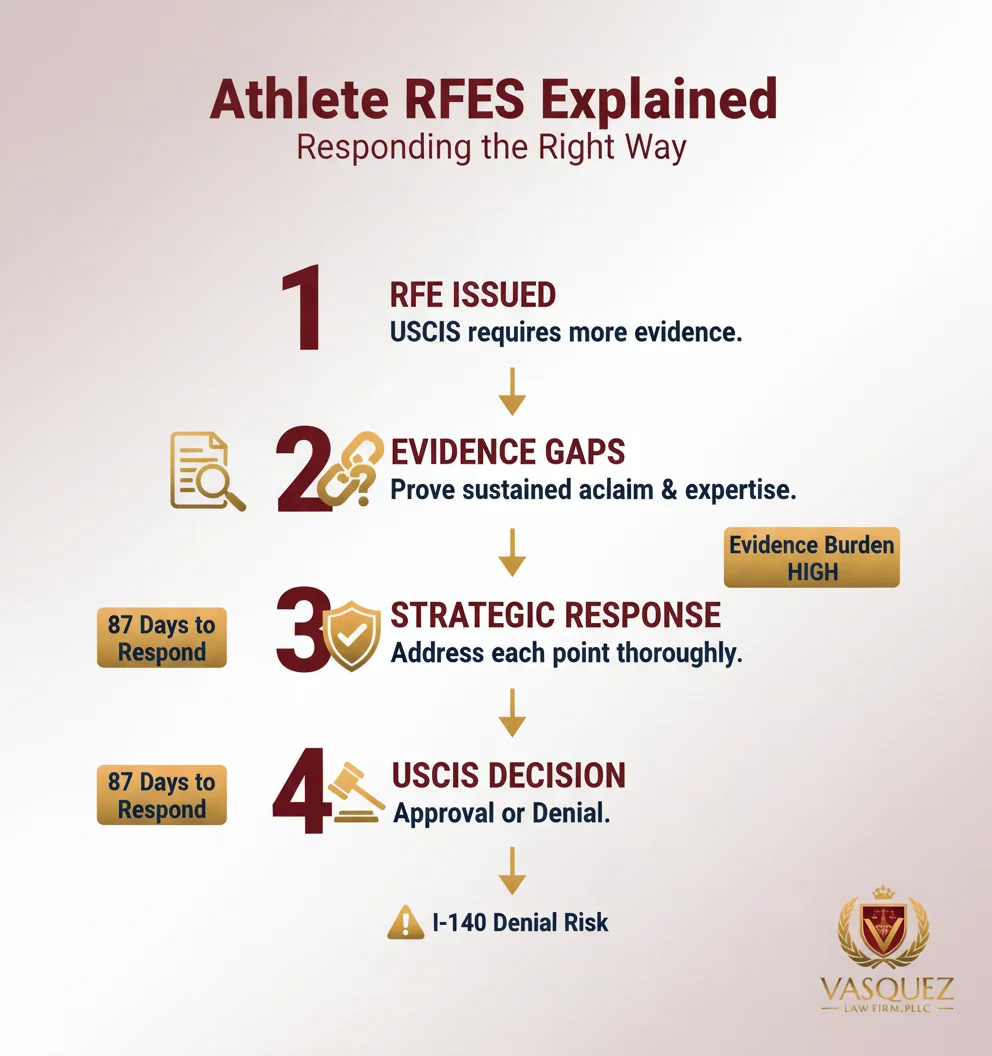
An RFE gives you a chance to fix problems, but it also pauses your case and starts a clock. If you miss the deadline or respond with weak evidence, USCIS can deny the petition based on what’s in the record.
What to Do in the Next 24-48 Hours
If this situation applies to you, take these steps NOW:
- Step 1: Build a single timeline (dates of contracts, seasons, entries/exits, prior filings, injuries/roster changes) and save it as a PDF for your records.
- Step 2: Audit your filing packet: confirm the job title, worksite, wage, and duties match across the PLC/PERM materials, the I-140, and supporting letters.
- Step 3: Gather “objective proof” (contracts, stats, rankings, media coverage, awards, federation letters) and label each item to match a legal requirement.
- Step 4: Consult with a legal expert to understand your rights and options
KEY TAKEAWAY:
Most athlete RFEs are not about talent—they are about evidence packaging. USCIS must be able to verify every required fact from the record, without guessing.
Warning Signs & Red Flags to Watch For
These are signs your case may be in jeopardy:
- Your RFE asks for “minimum requirements” proof (job duties, wage, worksite, employer-employee relationship) that you assumed was “obvious.”
- Your contracts, offer letters, and payroll/wage documents don’t match the role described in the petition.
- You changed teams, locations, or job terms after filing and no one documented whether an amended filing was needed.
Seeing these signs? Vasquez Law Firm, PLLC has handled hundreds of denied claims in North Carolina. Attorney Vasquez knows the tactics insurers use. Get a free case evaluation.
Your Rights: What You CAN and CANNOT Do
YOU HAVE THE RIGHT TO:

- Review the exact RFE language and submit a complete response by the deadline with indexed exhibits.
- Request missing records from your employer/team (contracts, wage records, job descriptions, organizational charts) to support the petition.
- Submit expert opinion letters and objective third-party proof (league/federation letters, rankings, press) when eligibility depends on professional standing.
YOU CANNOT:
- Ignore an RFE or assume USCIS will “find” documents from past filings—USCIS usually decides based on what you submit in that response window.
- Miss deadlines—RFE due dates are strict, and late submissions are commonly rejected or disregarded.
Vasquez Law Firm, PLLC helps North Carolina clients understand and protect their rights every day.
Documents You'll Need (Save This Checklist)
Gather these documents NOW (before they disappear):
- Signed contracts/offer letters (all versions), including addenda showing bonuses, seasons, and duties
- Payroll/wage proof (pay stubs, W-2/1099 where applicable, payment schedules) that matches the petition and labor filing
- Detailed job description and worksite information (where you train, compete, travel obligations, and reporting structure)
- Evidence of professional level (league registration, federation letters, rankings, stats, awards, press coverage)
- Immigration history file (I-94s, approval notices, prior RFEs/NOIDs, entry/exit dates)
Tip: Keep all documents organized in one folder - it makes the process much easier.
Legal Background and Context
USCIS has authority to request additional evidence when a petition does not establish eligibility. RFEs are part of how USCIS develops the record before it decides. Many RFEs focus on whether the filing meets the regulatory “initial evidence” requirements and whether the petitioner proved each element of the benefit requested.
What an RFE means under USCIS rules
USCIS generally issues RFEs under its adjudication rules when the record is missing initial evidence or when more proof is needed. You can read USCIS policy and procedural information directly at USCIS.gov.
From a legal strategy standpoint, an immigration lawyer treats an RFE like a checklist with consequences. The response should:
- Answer every question in the same order USCIS asked it
- Provide primary evidence first (contracts, payroll, official letters), then secondary evidence (press, screenshots)
- Explain inconsistencies plainly, with documentation
How PLC/PERM and I-140 fit together for athletes
Some professional athletes pursue employment-based permanent residence through a labor certification (PERM) path and then an I-140. Others may pursue categories that do not require PERM (depending on facts), but the warning in the news is a reminder: even when a category is appropriate, USCIS will still scrutinize whether the petition contains the required evidence.
If international travel is involved (tournaments, away games, training camps), check the Department of State’s visa resources at travel.state.gov so your documentation aligns with the visa and entry rules you rely on.
When RFE problems become removal or court issues
Most RFEs do not involve court. But immigration status problems can escalate if a denial triggers loss of work authorization or if a person falls out of status. If a case moves into removal proceedings, the system is handled through immigration court under the Executive Office for Immigration Review (EOIR). EOIR’s official information is at justice.gov/eoir.
For North Carolina residents, proceedings may be connected to the Charlotte Immigration Court, depending on the case and docket.
KEY TAKEAWAY:
USCIS adjudications are evidence-driven. If the filing doesn’t prove eligibility on paper, talent and good intentions won’t fill the gap.
How Vasquez Law Firm, PLLC Helps North Carolina Clients Win These Cases
When an athlete or team receives an RFE, speed matters—but accuracy matters more. A strong response is usually built like a case file: organized, indexed, and matched to the legal elements USCIS must decide.
Our approach to athlete RFEs and I-140 evidence
Our experienced team, led by Attorney Vasquez, has helped hundreds of North Carolina clients. Here's exactly how we help:
- Step 1: We review your case for free and tell you honestly if you have a claim
- Step 2: We handle all paperwork and deadlines so nothing gets missed
- Step 3: We fight insurance tactics - we know their playbook
- Step 4: We maximize your settlement or take it to hearing if needed
Common problems we fix before USCIS decides
In this RFE trend, the most common “fixes” are practical:
- Consistency: making sure wage, job title, dates, and duties match across every exhibit
- Clarity: translating sports-specific roles into clear employment terms USCIS can evaluate
- Proof: replacing assumptions with records (contracts, payroll, league documentation, expert letters)
Real example: "We recently helped a Charlotte construction worker whose claim was denied. Insurance said his injury 'wasn't work-related.' We gathered evidence, fought the denial, and won him $45,000 in benefits plus ongoing medical care." - Attorney Vasquez
Why local experience matters in North Carolina
Serving North Carolina residents means understanding local employment patterns and the practical realities of travel and scheduling. It also means you can meet a team that handles sensitive documents professionally and communicates clearly, including in Spanish (Se Habla Español).

Frequently Asked Questions (Specific to This Situation)
1) I’m a professional athlete—why did USCIS issue an RFE saying my I-140 “doesn’t meet minimum requirements”?
USCIS uses that wording when it believes the petition lacks required “initial evidence” or fails to clearly establish an element of eligibility. In athlete cases, common triggers include unclear job duties, unclear employer control, missing wage proof, or contracts that don’t match what the petition claims.
2) My team filed a PLC/PERM step—what evidence issues usually cause delays later at the I-140 stage?
Problems often start with mismatched job descriptions, worksites, or compensation details. If the labor filing describes one role and the I-140 packet describes another, USCIS may question whether the position is the same, whether the wage is consistent, and whether the employer can support the job offer as stated.
3) Does switching teams while my I-140 is pending increase my risk of an RFE in North Carolina?
It can. A team change can affect the petitioner, job offer, worksite, and whether an amended filing is required. USCIS will look for a clean explanation and documentation showing what changed, when it changed, and why eligibility still exists under the specific category being pursued.
4) The RFE asks for “employer-employee relationship” proof—what does that mean for an athlete?
USCIS often wants to see who controls the work: training schedules, performance expectations, discipline, who pays, and who can terminate the relationship. Helpful evidence includes organizational charts, coaching staff reporting lines, training requirements, payment records, and contract provisions showing supervision and control.
5) Can I travel for games or tournaments while an RFE is pending on my I-140?
Travel rules depend on your current status and any separate applications (like adjustment of status) that may require advance parole. Because athlete schedules are time-sensitive, confirm your travel plan against current visa/status rules and documentation guidance on the U.S. Department of State visa page, and align it with your pending filings.
6) How long do I have to respond to an I-140 RFE, and what happens if we miss the deadline?
RFEs include a specific due date. Missing it can lead to a denial based on the existing record, and USCIS may disregard late evidence. Build your response backward from the deadline, including time for translations, signature logistics, and obtaining league or federation letters.
7) If USCIS denies the I-140 after an RFE, does that automatically put me in immigration court in North Carolina?
Not automatically. A denial may affect your ability to stay or work, depending on your underlying status and any other pending applications. Court involvement depends on many factors and is handled through EOIR if removal proceedings are initiated. Official information about the court system is available at justice.gov/eoir.
Don't Navigate This Alone
If you're dealing with an RFE or potential denial tied to a PLC/PERM or I-140 athlete filing, Vasquez Law Firm, PLLC can help. With 15+ years serving North Carolina, we know what works.
Free consultation. Bilingual team. No fees unless we win.
Call Now: 1-844-967-3536
Se Habla Español - Hablamos Su Idioma
Free Legal Consultation
Discuss your case with our experienced attorneys. We're available 24/7.
Vasquez Law Firm
Legal Team
Our experienced attorneys at Vasquez Law Firm have been serving clients in North Carolina and Florida for over 20 years. We specialize in immigration, personal injury, criminal defense, workers compensation, and family law.