workers compensation lawyer NC: ALERT—DHS H-1B Rule Shift
workers compensation lawyer NC: DHS shifts H-1B odds to higher earners—injured workers may face new pressure at work. Learn steps, then request help.
Vasquez Law Firm
Published on December 23, 2025
workers compensation lawyer NC: ALERT—DHS H-1B Rule Shift
If you’re on a work visa and you get hurt on the job, you may feel trapped: report the injury and risk job problems, or stay quiet and risk your health. With DHS finalizing a rule that shifts H-1B odds toward higher earners, the pressure on injured workers can increase—especially when employers control payroll, job titles, and “prevailing wage” narratives. This post explains how a workers compensation lawyer NC looks at these cases so you can protect your medical care, wage benefits, and your future.
Quick Summary (Read This First)
What happened: DHS finalized a rule that shifts H-1B selection odds toward higher earners.
Why it matters to you: If you’re injured at work, employer decisions about wages, job status, and documentation can affect both workers’ comp benefits and immigration-related employment stability for North Carolina residents.
What to do now: Report injuries on time, document wage/job changes, and avoid signing settlements or “return to work” papers without understanding how they affect your benefits.
What This News Means for North Carolina Residents
According to reporting on the rule update, DHS finalized a rule shifting H-1B odds to higher earners. That may sound like “immigration-only” news, but it can spill into workplace decisions—especially in industries that hire skilled workers and track wages closely.
Why wage changes can hit injured workers first
When someone is injured, employers and insurance carriers often focus on work restrictions, job duties, and pay. For H-1B workers, those same details can become high-stakes because pay level, hours, and job classification are closely documented. If an employer reduces hours, changes titles, or delays pay after an injury, it can create a paper trail that is bad for both your workers’ comp claim and your sense of security.
Workers’ comp is state law; immigration is federal (but your life is one life)
North Carolina workers’ compensation is governed by the North Carolina Workers’ Compensation Act (Chapter 97). The H-1B system is federal. They are different systems, but they can collide in real life when an injured worker worries about being replaced, “benched,” or pushed out after reporting an injury.
Who is most exposed
This issue often shows up for people in healthcare, IT, manufacturing, research, and construction management—anywhere pay rates, classifications, and “essential duties” are tracked. If you are in North Carolina and you’re working under an employment-based visa, the safest assumption is this: after an injury, every email, pay stub, and job-duty change matters more than you think.
What to Do in the Next 24-48 Hours
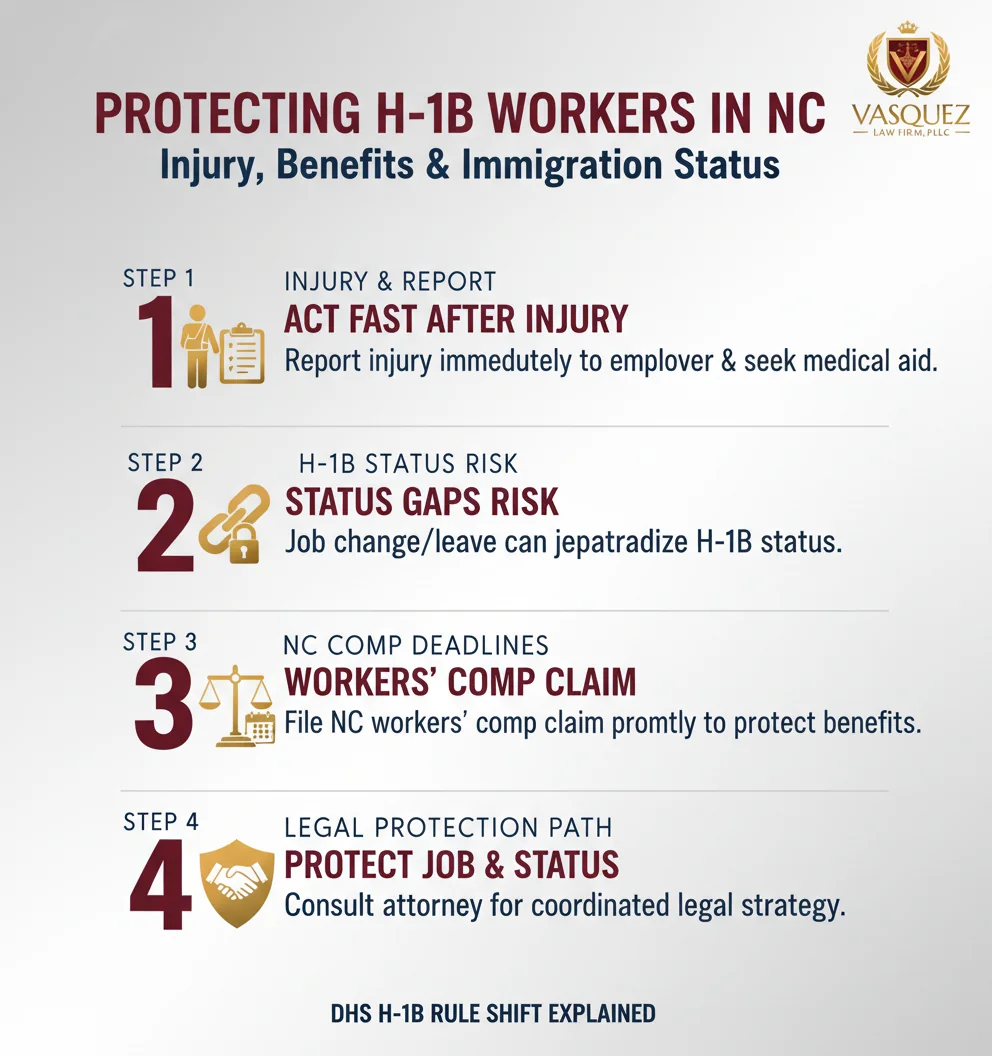
If this situation applies to you, take these steps NOW:
- Step 1: Document everything—take photos, save texts/emails, and write down dates, supervisors’ names, and what happened.
- Step 2: Give written notice to your employer as soon as possible (North Carolina has strict notice rules; delays create denial risks).
- Step 3: Track wage and job changes immediately—save pay stubs, schedules, and any new job title, pay rate, or “light duty” offer in writing.
- Step 4: Do NOT sign a settlement, resignation, “voluntary quit,” or a return-to-work form you don’t understand—those documents can affect benefits and your job record.
Why the first 24–48 hours matters
Insurers often decide early whether to accept, deny, or “investigate” a claim. Early records—incident reports, first medical notes, and initial wage data—tend to become the backbone of the case. If the first version of events is incomplete, it can haunt you for months.
Protect your medical story
Tell the treating provider exactly how the injury happened and what job tasks you were doing. If your first medical note sounds like the injury happened “at home” or is “not work-related,” insurers may use that language to deny the claim.
Keep immigration papers separate (but organized)
Workers’ comp does not require you to prove immigration status to get medical treatment for a work injury. Still, keep your immigration and employment documents organized, because an employer dispute can lead to sudden job changes that affect your stability.
Warning Signs & Red Flags to Watch For
These are signs your case may be in jeopardy:
- Your employer pressures you to return to work before your doctor clears you—or threatens your job if you follow restrictions.
- The insurance carrier delays authorization for treatment, requests repeated “extra” paperwork, or schedules confusing recorded statements.
- You’re told you “don’t qualify” because you’re on a visa, a contractor, or “not full-time,” even though you were doing work for the employer.
Seeing these signs? Vasquez Law Firm, PLLC has handled hundreds of denied claims in North Carolina. Attorney Vasquez knows the tactics insurers use. Get a free case evaluation.
A new pressure point: wage levels and “papering” the file
When policy changes emphasize higher wages, some employers may become more sensitive to payroll and classification issues. After an injury, that can show up as sudden “performance” write-ups, changes to hours, or job duty edits that make it seem like your limits are not real.
Watch for retaliation signals (even subtle ones)
Retaliation is not always a direct threat. It can be schedule cuts, being moved to a worse job, or being told you’re “not a team player” for asking for medical care. These patterns matter in a disputed claim file.
Your Rights: What You CAN and CANNOT Do
YOU HAVE THE RIGHT TO:

- Report a work injury and seek medical treatment without being “disqualified” just because you are on a visa.
- Receive wage-replacement benefits if you meet the legal requirements and your disability impacts earning capacity.
- Challenge a denial and request a hearing through the North Carolina Industrial Commission process.
YOU CANNOT:
- Ignore deadlines—late notice and late filings are a common reason carriers deny otherwise valid claims.
- Assume a “light duty” offer is safe—if it violates your restrictions or changes your wages, it can affect benefits and your health.
Vasquez Law Firm, PLLC helps North Carolina clients understand and protect their rights every day.
Your status does not erase the injury
A work injury is a medical and legal event. If you were performing work for the employer and you were hurt in the course of employment, your claim should be evaluated under Chapter 97, not rumors about who “counts.” A workers compensation lawyer NC will usually start by identifying the true employment relationship and the real wage picture.
Be careful with recorded statements
Insurers may ask for a recorded statement early. Small wording mistakes can be used later to claim the injury happened off the clock, during a personal errand, or was “pre-existing.” If you do provide a statement, keep it factual, short, and consistent with the medical record.
Documents You'll Need (Save This Checklist)
Gather these documents NOW (before they disappear):
- Incident report (or any email/text where you reported the injury)
- All medical records, work notes, restrictions, and prescriptions
- Photos of the scene, equipment, hazards, and visible injuries
- Witness names and contact information
- Pay stubs, W-2/1099 forms (if any), schedules, and offer letters showing your normal pay
Tip: Keep all documents organized in one folder - it makes the process much easier.
Add these if you’re an H-1B worker
Because the news relates to H-1B wage emphasis, keep extra employment proof that explains your role and pay:
- Offer letter and job description
- Recent performance reviews (if they were positive before the injury)
- Any notice of pay changes, benching, reduced hours, or role changes after the injury
- Timesheets or badge logs that confirm where you were when the injury occurred
Why pay records matter in North Carolina workers’ comp
Wage benefits are tied to your “average weekly wage” (AWW). Missing pay documents can cause the carrier to calculate the AWW in a way that is too low. A workers compensation lawyer NC will often audit wage calculations and push back when the math does not reflect reality.
KEY TAKEAWAY:
In North Carolina, a late report is one of the easiest ways for an insurer to attack your credibility. If you were hurt at work, create a clear written record of notice as soon as possible and keep proof you sent it.
Legal Background and Context
North Carolina workers’ compensation is handled through the North Carolina Industrial Commission (often called the “NCIC”), headquartered in Raleigh. The NCIC oversees claims, forms, mediation, and hearings.
Core rules that control most cases
Here are a few legal anchors that come up in many claims:
- Notice to the employer: North Carolina law has notice requirements that can affect benefits if an injury is not timely reported (see N.C. Gen. Stat. § 97-22).
- How claims start: Many claims are initiated with NCIC forms (often a Form 18 for an injured worker’s notice/claim).
- Wage replacement and disability: Benefits depend on medical proof, work restrictions, and how the injury affects your ability to earn wages.
How the H-1B news connects to workers’ comp
DHS’s focus on higher earners can amplify two common workers’ comp disputes:
- Wage disputes: If an employer changes hours or pay after an injury, the insurer may argue your wage loss is “not because of the injury.”
- Job-duty disputes: If job duties are rewritten after the injury, the insurer may claim you can do “your job,” even when the job has been changed on paper.
Authoritative references you can check
For official information on the claims process, forms, and hearing procedures, review the NCIC site: ic.nc.gov. For federal workers’ rights context, the U.S. Department of Labor provides workplace guidance at dol.gov.
How Vasquez Law Firm, PLLC Helps North Carolina Clients Win These Cases
Our experienced team, led by Attorney Vasquez, has helped hundreds of North Carolina clients. Here’s how we approach injury claims where wage pressure, job changes, or visa-related fear creates extra risk. If you searched for a workers compensation lawyer NC, these are the exact pressure points we look for early.
We build the paper trail insurers cannot ignore
- Step 1: We review the timeline (injury, notice, first treatment, restrictions) and spot denial triggers.
- Step 2: We organize proof of wages and duties (pay stubs, schedules, job description, written light-duty offers).
- Step 3: We challenge “not work-related” arguments by aligning witness info, safety logs, and medical notes.
We push back on common insurance tactics
Carriers may delay care, claim you can return to work too soon, or try to lock you into a low AWW. A workers compensation lawyer NC can help keep the claim moving, escalate disputes properly, and prepare the case for mediation or hearing when needed.
Real example
Real example: “We recently helped a Charlotte construction worker whose claim was denied. Insurance said his injury ‘wasn’t work-related.’ We gathered evidence, fought the denial, and won him $45,000 in benefits plus ongoing medical care.” - Attorney Vasquez
Attorney Vasquez, JD, has 15 years of experience and is admitted to the North Carolina State Bar and the Florida Bar. Our team is bilingual—Se Habla Español—so clients can explain injuries, restrictions, and job changes clearly.


Frequently Asked Questions (Specific to This Situation)
1) Does the DHS H-1B “higher earners” rule change my North Carolina workers’ comp rights?
No. The rule discussed in the news is federal and relates to H-1B selection. Your right to medical treatment and wage benefits for a work injury in North Carolina is based on Chapter 97 and NCIC procedures. But the rule can increase workplace pressure around wages and job status, which can indirectly affect how employers document your role after an injury.
2) My employer reduced my hours after I reported an injury—can the insurance company use that against me?
They may try. Insurers often argue wage loss is “economic” or “unrelated” to the injury. That’s why you should preserve written proof of restrictions, light-duty offers, and any wage or schedule changes. A workers compensation lawyer NC often focuses on connecting the wage loss to medical limits and documenting that the job offered was not suitable or not actually available.
3) I’m on H-1B and I’m scared to report my injury because I might lose my job—what is the safest approach?
From a workers’ comp standpoint, timely reporting and prompt medical documentation are critical. Quietly “toughing it out” can lead to worse injuries and make the claim harder to prove later. Because immigration consequences can be serious and fact-specific, consider getting immigration advice as well, but do not delay necessary medical care or fail to create a clear injury record.
4) My company offered “light duty,” but they changed my title and pay—does that affect my claim?
It can. In North Carolina, suitable employment and wage calculations are key issues. If the “light duty” role is not within restrictions, is not real work, or is used to reduce your earnings, it may impact eligibility for wage-replacement benefits. Save the offer in writing and compare it to your doctor’s restrictions.
5) They say I’m a contractor because I’m on a visa—does that block workers’ comp?
Not automatically. Employers sometimes label workers as contractors, but the legal test looks at the reality of control and the work relationship. If the employer directs how, when, and where you work, you may still qualify. This is a common area where a workers compensation lawyer NC can investigate the true employment status.
6) If my claim is denied, where does the dispute get decided in North Carolina?
Disputes are handled through the North Carolina Industrial Commission process. Many cases involve mediation first, and unresolved disputes can proceed to a hearing before a Deputy Commissioner. Keeping organized records from day one matters because those documents often become evidence.
7) Will a workers’ comp settlement affect my future employment paperwork?
A settlement may include language about resignation, job separation, or release of claims. That language can matter for your work history and should be reviewed carefully before you sign. Also, settlement type (for example, a “clincher” agreement) can close out future medical benefits, which is a major decision if you still need care.
Don't Navigate This Alone
If you're dealing with wage pressure, job changes, or a denied claim after a work injury, Vasquez Law Firm, PLLC can help. With 15+ years serving North Carolina, we know what works.
Free consultation. Bilingual team. No fees unless we win.
Call Now: 1-844-967-3536
Se Habla Español - Hablamos Su Idioma
Free Legal Consultation
Discuss your case with our experienced attorneys. We're available 24/7.
Vasquez Law Firm
Legal Team
Our experienced attorneys at Vasquez Law Firm have been serving clients in North Carolina and Florida for over 20 years. We specialize in immigration, personal injury, criminal defense, workers compensation, and family law.