workers compensation lawyer NC: What Michigan Judges Won't Tell
workers compensation lawyer NC: Michigan’s 2025 rulings signal tougher claim fights. Learn the 24–48 hour steps to protect benefits—Se Habla Español.
Vasquez Law Firm
Published on December 22, 2025

workers compensation lawyer NC: What Michigan Judges Won't Tell
If you’re searching for a workers compensation lawyer NC, here’s the uncomfortable truth: big court rulings—even outside the state—often predict the next insurance playbook. A recent roundup of Michigan’s 5 biggest court rulings of 2025 is a reminder that insurers watch the courts closely, then adjust how they investigate, deny, and settle workplace injury claims.
Quick Summary (Read This First)
What happened: A national legal outlet highlighted Michigan’s five most significant employment-related court rulings of 2025.
Why it matters to you: Even though the cases are from another state, the themes (causation disputes, medical proof fights, and narrowing/expanding worker protections) often show up next in how claims are handled for injured workers in North Carolina.
What to do now: Report the injury in writing, get the right medical documentation, and track every missed day and restriction—before the record gets shaped against you.
What This News Means for North Carolina Residents
What the Michigan rulings signal (even if you live here)
Legal news often works like a weather report. When courts publish major rulings, employers and insurers study them. They don’t need those cases to be binding in North Carolina to borrow the arguments.
That’s why the roundup of major decisions—Michigan's 5 Biggest Court Rulings Of 2025 (Law360)—matters to workers here. It’s a snapshot of where employment and injury disputes are being fought: medical causation, work status classification, and how evidence is evaluated.
Why insurers care about “trend” rulings
In practice, insurers adjust their claim handling when courts reward certain defenses. That can mean more requests for records, more challenges to whether an injury is truly work-related, or more pressure to accept quick settlements.
The North Carolina reality check
North Carolina workers’ compensation is governed by state law (Chapter 97) and managed through the North Carolina Industrial Commission. But the tactics used to dispute claims can look the same across states: delay, deny, and demand documentation.
KEY TAKEAWAY:
Out-of-state rulings can’t change North Carolina law overnight—but they often preview the exact arguments insurers will use to challenge your medical proof, your restrictions, or whether your condition “counts” as work-related.
What to Do in the Next 24-48 Hours
Your goal: lock in the facts before they get rewritten
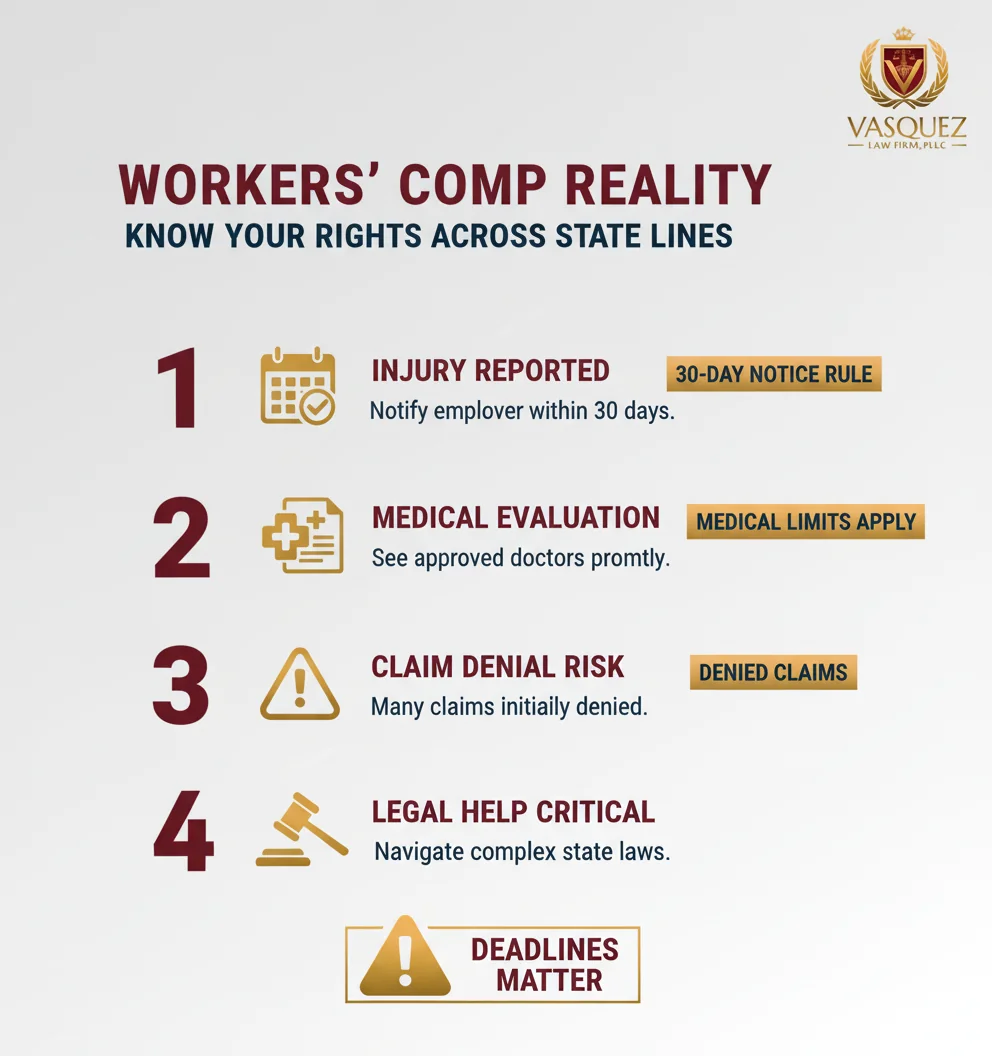
The first 24–48 hours after a work injury are when the paper trail is created. If the record is vague or inconsistent, insurers often treat that as an opening to dispute compensability.
Focus on three buckets: notice, care, and documentation
Think of your claim like a three-legged stool: (1) timely notice to the employer, (2) medical care tied to the workplace event, and (3) documentation that connects the dots.
If this situation applies to you, take these steps NOW:
- Step 1: Document everything—photos, equipment condition, job assignment, the exact time, and who saw it. Write a short timeline while it’s fresh.
- Step 2: Report the injury to your supervisor/HR in writing and keep a copy. In NC, delayed notice can create real problems later.
- Step 3: Get medical care and clearly explain “This happened at work, doing ___.” Ask the provider to note work restrictions and whether the condition is work-related.
- Step 4: Consult with a legal expert to understand your rights and options
Avoid fast mistakes that become permanent
Be careful with casual statements like “It’s probably nothing,” or “I’ve had this pain before.” Insurers may later argue your injury is not connected to work, or that it’s a pre-existing condition that wasn’t aggravated on the job.
Warning Signs & Red Flags to Watch For
Red flags that often show up right before a denial
When court trends favor stricter proof standards, insurers often respond by demanding “perfect” documentation. Watch for these common signals.
Red flags that suggest pressure tactics
Some employers and adjusters push for quick returns to work or quick settlements. That can be risky if your condition needs ongoing care.
These are signs your case may be in jeopardy:
- Your employer is pressuring you to return to work before your doctor clears you (or before restrictions are understood).
- The insurance adjuster keeps “resetting” the investigation and requesting the same records repeatedly, delaying authorizations or checks.
- You’re told you don’t qualify because you were “off the clock,” a “contractor,” or the injury is “pre-existing,” without a real review of the facts.
Seeing these signs? Vasquez Law Firm, PLLC has handled hundreds of denied claims in North Carolina. Attorney Vasquez knows the tactics insurers use. Get a free case evaluation.
Your Rights: What You CAN and CANNOT Do
Medical care and restrictions: what you can control remember
Workers’ comp is not just “did you get hurt?” It’s also “can you prove it through medical evidence and work restrictions?” That’s where many disputes live.

Work status: light duty, reduced hours, and wage loss
Your benefits can depend on whether the employer offers suitable work within restrictions and how your wages change. Track hours, pay, and tasks.
YOU HAVE THE RIGHT TO:
- Receive medical treatment reasonably required to cure, provide relief, or lessen the period of disability (generally tied to N.C. Gen. Stat. § 97-25).
- Have wage replacement benefits considered if work restrictions keep you out of work or reduce earnings (often involving N.C. Gen. Stat. §§ 97-29 and 97-30).
- Challenge a denial and request a hearing through the North Carolina Industrial Commission.
YOU CANNOT:
- Assume a verbal report is enough—notice problems can harm the claim (N.C. Gen. Stat. § 97-22 is a key notice rule).
- Ignore deadlines or paperwork—workers’ comp is deadline-driven and delays can reduce leverage.
Vasquez Law Firm, PLLC helps North Carolina clients understand and protect their rights every day.
KEY TAKEAWAY:
In many disputed claims, the fight isn’t “did it hurt?”—it’s “can the worker prove causation with consistent reporting, consistent medical notes, and a clean timeline?”
Documents You'll Need (Save This Checklist)
Why documents matter more than people expect
The insurer’s decision is often driven by documents, not your verbal explanation. If an out-of-state ruling tightens what counts as “enough proof,” your paperwork matters even more.
Prioritize the items that prove time, place, and medical link
Collect documents that show: (1) you were working, (2) what happened, and (3) what your doctor says you can and cannot do.
Gather these documents NOW (before they disappear):
- Written notice to your employer (email, text screenshot, or incident report) and the date you reported it.
- All medical records, work notes, restrictions, referrals, imaging results, and prescriptions.
- Photos/video of the scene, equipment, safety issues, and visible injuries (if appropriate).
- Witness names, phone numbers, and brief statements (even a text message confirming what they saw).
- Pay stubs (before and after injury), time sheets, and any light-duty schedule showing reduced hours or tasks.
Tip: Keep all documents organized in one folder - it makes the process much easier.
KEY TAKEAWAY:
The best time to gather proof is before there’s a dispute. Once a claim is questioned, missing records and unclear timelines become “reasons” to deny.
Legal Background and Context
Who runs workers’ comp in North Carolina?
Workers’ compensation claims in North Carolina are administered through the North Carolina Industrial Commission (NCIC). The NCIC oversees disputes, approvals of certain settlements, and the hearing process when a claim is denied or benefits are cut off.
The core law: North Carolina Chapter 97
Most rights and deadlines come from the Workers’ Compensation Act (Chapter 97). Key provisions include notice requirements and medical compensation. For example, N.C. Gen. Stat. § 97-22 addresses notice to the employer, and § 97-25 addresses medical compensation. You can review the statutory text here: North Carolina General Statutes, Chapter 97.
So why talk about Michigan rulings at all?
Michigan rulings don’t control NC courts. But they can highlight disputes that are becoming more common nationwide—like how courts weigh medical opinions, what counts as a work connection, and how employers classify workers. Those themes influence how insurance carriers investigate claims, including the level of proof they demand.
That is exactly why people often look for a workers compensation lawyer NC when the adjuster starts asking for “just one more record,” questions whether your job duties caused the injury, or disputes work restrictions.
KEY TAKEAWAY:
When courts spotlight employment disputes, insurers often tighten claim reviews. That makes early reporting, clean medical documentation, and consistent work restrictions even more important.
How Vasquez Law Firm, PLLC Helps North Carolina Clients Win These Cases
How we approach disputed and delayed claims
Disputes tend to cluster around the same pressure points: whether the injury is work-related, whether the medical evidence supports disability, and whether the insurer is paying the right benefits. A workers compensation lawyer NC should know how to build proof around those issues, not just “file forms.”

What strong case preparation looks like
Our process focuses on clarity and leverage—so the file tells the story before the insurer tries to control it.
Our experienced team, led by Attorney Vasquez, has helped hundreds of North Carolina clients. Here's exactly how we help:
- Step 1: We review your case for free and tell you honestly if you have a claim
- Step 2: We handle all paperwork and deadlines so nothing gets missed
- Step 3: We fight insurance tactics - we know their playbook
- Step 4: We maximize your settlement or take it to hearing if needed
Why this matters in a “tougher proof” climate
When claim handling becomes stricter, small gaps become big problems. That’s why many injured workers look for a workers compensation lawyer NC after a denial, a sudden stop in checks, or a dispute about returning to work.
Real example: "We recently helped a Charlotte construction worker whose claim was denied. Insurance said his injury 'wasn't work-related.' We gathered evidence, fought the denial, and won him $45,000 in benefits plus ongoing medical care." - Attorney Vasquez
Se Habla Español. Vasquez Law Firm, PLLC regularly assists bilingual families who need clear explanations of restrictions, benefits, and next steps.
Frequently Asked Questions (Specific to This Situation)
Questions workers ask after reading about big court rulings
When you see headlines about major employment rulings (even from another state), it’s normal to wonder whether your own claim will get harder. These are the questions we hear most often in this moment.
Questions about proof, causation, and documentation
Insurers tend to lean into “proof problems” when legal trends favor stricter interpretations. These FAQs focus on the practical impact that can have on NC claims.
Questions for multistate employers and traveling workers
If your employer operates across state lines—or you travel for work—jurisdiction and reporting can get complicated quickly.
- If my employer is using the Michigan rulings as an excuse to deny my NC claim, does that matter?
Michigan decisions don’t control North Carolina workers’ comp. But an adjuster may use similar arguments (like disputing causation or work status). Your claim still rises or falls under North Carolina law and the evidence in your file. - After these “big rulings,” can the insurance company demand extra medical proof before paying?
They often try. In practice, that can mean more record requests, more scrutiny of restrictions, and more disputes about whether the work event caused the condition. Strong, consistent medical notes that link the injury to job duties are critical. - What if I was hurt in North Carolina but my company is headquartered in Michigan?
Headquarters location usually doesn’t decide the claim. Where you were working and where the employment is centered often matters more. If there’s any dispute about which state’s system applies, get advice quickly because deadlines and benefits can differ. - Does a prior injury or arthritis automatically let the insurer deny my claim?
Not automatically. Insurers often argue a condition is pre-existing, but NC law can still allow benefits when work aggravates or accelerates a condition. The outcome depends on medical causation evidence and how your doctor explains it. - If the adjuster schedules a recorded statement after these rulings, should I be worried?
Be careful. Recorded statements can be used to highlight inconsistencies (dates, job tasks, prior symptoms). If you’re unsure, it’s smart to get legal guidance before giving a statement so you don’t accidentally harm your claim. - Can my benefits stop if I try light-duty work and it doesn’t work out?
It depends on restrictions, the suitability of the job offered, and why it failed. Document the tasks you were asked to do, any pain or inability to perform, and notify the doctor promptly so restrictions can be clarified in writing. - Is it normal for the insurer to delay authorizing specialists or MRIs when “courts are tightening standards”?
Delays happen often in disputed cases. Keep a written log of requests, dates, and responses. Treatment disputes can be addressed through the NC Industrial Commission process when the insurer refuses or stalls necessary care.
Don't Navigate This Alone
If you're dealing with a denied, delayed, or disputed North Carolina workers’ compensation claim, Vasquez Law Firm, PLLC can help. With 15+ years serving North Carolina, we know what works.
Free consultation. Bilingual team. No fees unless we win.
Call Now: 1-844-967-3536
Se Habla Español - Hablamos Su Idioma
Free Legal Consultation
Discuss your case with our experienced attorneys. We're available 24/7.
Vasquez Law Firm
Legal Team
Our experienced attorneys at Vasquez Law Firm have been serving clients in North Carolina and Florida for over 20 years. We specialize in immigration, personal injury, criminal defense, workers compensation, and family law.