Immigration lawyer: WARNING—DHS ending the H‑1B lottery?
Immigration lawyer explains how DHS H‑1B rule changes could affect NC workers and employers. Get help fast—call 1-844-967-3536 or visit /contact.
Vasquez Law Firm
Published on December 23, 2025
Immigration lawyer: WARNING—DHS ending the H‑1B lottery?
If you rely on an H‑1B (or you’re an employer filing them), the latest reports about DHS possibly ending the H‑1B lottery can feel like the rug is being pulled out. An immigration lawyer can help you spot what changes are real, what’s still proposed, and what you should do right now to protect your job, your status, and your long-term plans in North Carolina.
Quick Summary (Read This First)
What happened: A recent report says DHS may move away from the traditional random H‑1B lottery and tighten selection/registration rules.
Why it matters to you: If you work in tech, healthcare, higher education, or staffing—or you’re a North Carolina employer hiring global talent—your odds, timing, and evidence requirements may change fast.
What to do now: Confirm your current status timeline, strengthen your job/role documentation, and plan backup options (cap-exempt, STEM OPT, O‑1, L‑1, or family-based paths) before the next filing cycle.
What This News Means for North Carolina Residents
According to the report, DHS could revise how H‑1B registrations are selected and how misuse is policed—potentially reducing the role of pure chance in who gets picked. You can read the coverage here: CNBC TV18 report on new H‑1B rules and the lottery.
For North Carolina residents, the practical concern is simple: many people plan their lives around the H‑1B “cap season” calendar. A change in selection rules can affect:
- F‑1 students on OPT/STEM OPT in Raleigh, Durham, Chapel Hill, and Charlotte who need an H‑1B to keep working after OPT ends.
- Employers who depend on international hiring for software engineering, data, biotech, finance, and specialized healthcare roles.
- Families whose housing, school, and travel plans depend on whether the worker stays employed and in status.
Why North Carolina is especially sensitive to H‑1B shifts
North Carolina has major universities, a growing tech corridor, and healthcare systems that often recruit internationally. When H‑1B selection or compliance rules tighten, employers may become more cautious about filing, and workers may have fewer “tries” before their OPT time runs out.
What “ending the lottery” could mean (and what it doesn’t)
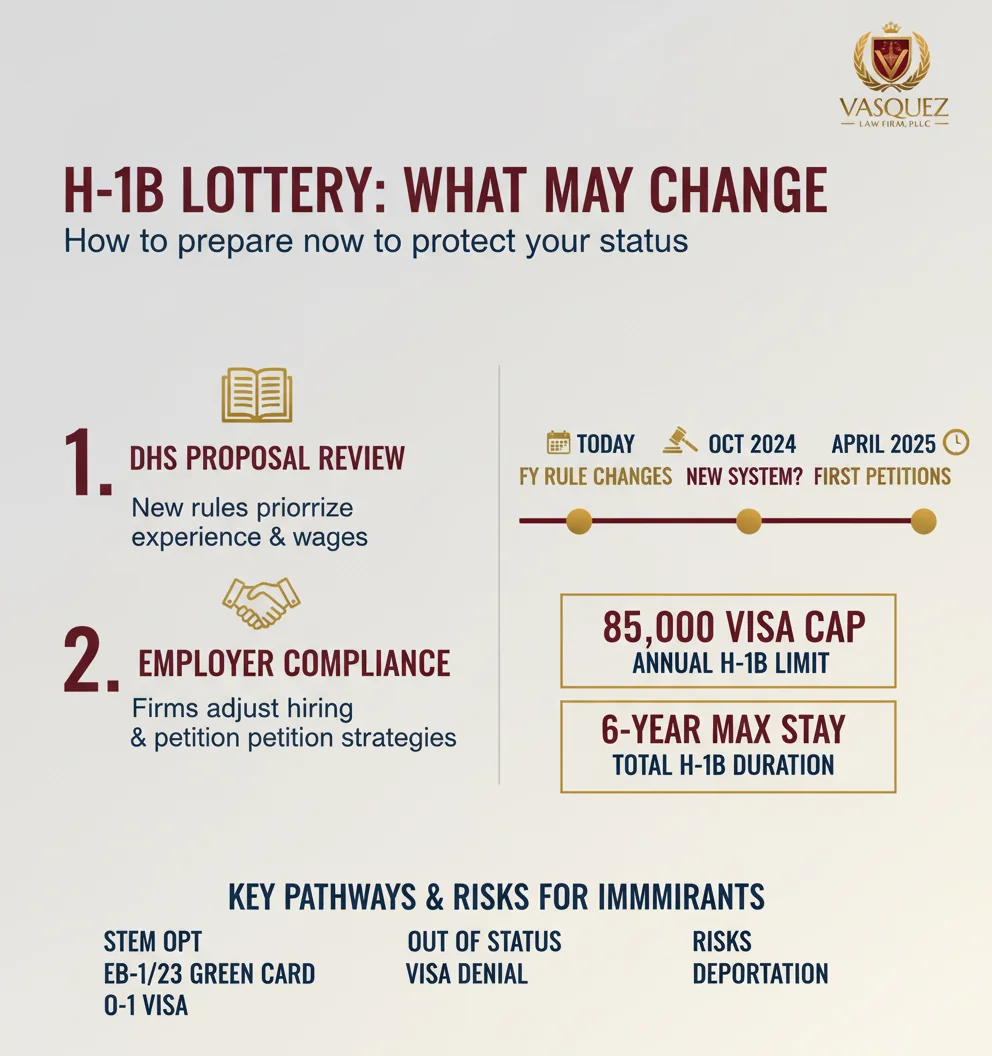
People hear “ending the lottery” and assume H‑1Bs are “stopped.” That is usually not what it means. More often, it means DHS could adjust how USCIS selects cap cases (for example, prioritizing certain wage levels or using other ranking criteria) and increase enforcement against duplicate registrations.
Why an immigration strategy matters more than ever
When selection rules shift, the winning cases are often the ones that are the most defensible on paper: clear specialty occupation duties, strong degree alignment, consistent wage/leveling logic, and clean documentation. This is where working with an immigration lawyer can reduce risk—especially for staffing, third‑party placement, and fast-moving job changes.
What to Do in the Next 24-48 Hours
If this situation applies to you, take these steps NOW:
- Step 1: Build a “status timeline” (OPT dates, I‑94 end date, passport expiry, prior H‑1B filings, travel plans) and save it as a PDF.
- Step 2: Ask your employer for your current job description, work location(s), salary, and reporting structure—then compare it to your degree and resume for consistency.
- Step 3: If you are on OPT/STEM OPT, confirm your I‑983 training plan is accurate and signed, and that your employer’s E‑Verify info matches what was used for STEM.
- Step 4: Consult with a legal expert to understand your rights and options
KEY TAKEAWAY:
In H‑1B season, small inconsistencies (worksite, job level, duties, degree match) can trigger Requests for Evidence (RFEs) or denials. Fixing documentation now is far easier than reacting under a filing deadline.
Warning Signs & Red Flags to Watch For
These are signs your case may be in jeopardy:
- Your employer wants to file multiple registrations through related companies or different recruiters “to increase odds.”
- You are placed at a third-party client site, but your paperwork doesn’t clearly show who supervises you, what you do daily, and where you work.
- You are told to accept a lower wage level that doesn’t match your experience, or your offered wage does not align with the role’s requirements.
Seeing these signs? Vasquez Law Firm, PLLC has handled hundreds of denied claims in North Carolina. Attorney Vasquez knows the tactics insurers use. Get a free case evaluation.
Your Rights: What You CAN and CANNOT Do
YOU HAVE THE RIGHT TO:
- Ask your employer for copies of filings that affect you (for example, the H‑1B petition and Labor Condition Application details), and to understand the job terms being represented.
- Change employers through a new H‑1B petition (H‑1B “portability”) when eligible—timing and documentation matter.
- Consult counsel privately about options like cap‑exempt H‑1B, O‑1, L‑1, TN (if applicable), or family-based strategies.
YOU CANNOT:

- Work outside the terms of your current status (wrong employer, wrong worksite, or unauthorized “side work”) without understanding the immigration consequences.
- Assume “everyone does it” is a defense—duplicate registrations, fake end-clients, or inflated duties can lead to denials and fraud findings.
Vasquez Law Firm, PLLC helps North Carolina clients understand and protect their rights every day.
Documents You'll Need (Save This Checklist)
Gather these documents NOW (before they disappear):
- Passport biographic page, visa stamp (if any), and most recent I‑94 record.
- All prior I‑20s (F‑1), EAD cards, OPT/STEM OPT approvals, and I‑983 (if on STEM OPT).
- Offer letter, current job description, org chart, and a detailed list of weekly duties (real tasks, not just a title).
- Pay stubs (last 3 months), W‑2s/1099s (as applicable), and a current employment verification letter.
- Diplomas, transcripts, credential evaluations (if foreign degree), and professional licenses/certifications relevant to the role.
Tip: Keep all documents organized in one folder - it makes the process much easier.
KEY TAKEAWAY:
If DHS tightens selection and enforcement, documentation becomes the difference between an approvable case and a denial—even when the applicant is highly qualified.
Legal Background and Context
H‑1B visas are governed by federal statute and regulation, and USCIS can update how it administers selection and adjudication through rulemaking and policy changes. The core framework is based on the employer sponsoring a “specialty occupation” job and maintaining compliance with wage and worksite requirements.
Where the key H‑1B rules come from
Two major sources matter for most H‑1B cases:
- USCIS program requirements and procedures (forms, filings, and selection mechanics). The official agency hub is USCIS.gov.
- Regulations in 8 C.F.R. § 214.2(h), which outline eligibility, petitions, and employer/employee terms.
Selection changes vs. petition approval
Even if the selection system changes, the petition still has to be approvable. That means USCIS can still issue RFEs about specialty occupation, employer-employee relationship, worksite details, and whether the wage level fits the duties.
Travel, visa stamping, and consular processing
Many North Carolina workers travel abroad and need visa stamping at a U.S. consulate. Visa issuance is handled by the Department of State, not USCIS. For stamping basics and country-specific guidance, see U.S. Department of State—U.S. Visas.
KEY TAKEAWAY:
A rule headline can change the “front door” (selection), but the “back room” (adjudication standards and evidence) still decides whether you actually get approved.
How Vasquez Law Firm, PLLC Helps North Carolina Clients Win These Cases
For many families, the hardest part isn’t the form—it’s the uncertainty. Vasquez Law Firm, PLLC focuses on building filings that are consistent, well-documented, and realistic under the current enforcement climate. Our team is led by Attorney Vasquez (JD), who has 15 years of experience and is admitted to the North Carolina State Bar and the Florida Bar. Se Habla Español.
What we focus on when DHS tightens H‑1B rules
- Role clarity: We translate what you actually do into duties USCIS can understand and verify.
- Degree alignment: We connect the job requirements to the field of study with credible, easy-to-follow evidence.
- Worksite & supervision: For third-party placements or hybrid work, we document who controls the work, where it happens, and how compliance is maintained.
- Backup planning: When timing is tight, we map options that can lawfully bridge gaps (or reduce risk of falling out of status).
Serving North Carolina residents and employers
We regularly assist clients across North Carolina, including the Charlotte and Raleigh-Durham areas, and we understand how fast job offers, start dates, and project assignments can change.
Real example
Real example: “A North Carolina software professional had an H‑1B filing that was heading toward an RFE because the job duties were too generic and the worksite plan kept changing. We rebuilt the evidence with a stronger duty breakdown, wage logic, and supervision/worksite documentation, and the case was approved—allowing the client to stay employed and keep their long-term immigration plan on track.” — Attorney Vasquez
If your situation involves removal proceedings or you need to understand immigration court timelines, the Executive Office for Immigration Review provides official court information at justice.gov/eoir. (For North Carolina, the Charlotte Immigration Court is a common venue for many cases.)
Frequently Asked Questions (Specific to This Situation)
1) If DHS changes the H‑1B lottery, does that affect my current H‑1B in North Carolina?
Usually, changes aimed at selection primarily affect new cap filings. If you already have approved H‑1B status, your main risk is still compliance: staying within the approved employer/role terms, maintaining pay and worksite rules, and filing amendments when required. An immigration lawyer can review whether your current duties and location still match what was filed.

2) I’m on F‑1 OPT/STEM OPT in North Carolina—what should I do if I’m not selected?
Your options depend on your remaining OPT time, employer type, and whether you qualify for another work-authorized status. Common strategies include cap‑exempt H‑1B (if the employer qualifies), O‑1 (extraordinary ability), L‑1 (for intracompany transfers), or family-based alternatives. Timing is critical because OPT/STEM has strict end dates and reporting requirements.
3) My employer uses a staffing model with third-party worksites—does tighter enforcement make my case harder?
It can. Third-party placement cases often draw scrutiny about specialty occupation and the employer-employee relationship. You may need clearer evidence of who supervises you, where you work, and what your day-to-day tasks are. If DHS increases enforcement against questionable registrations, clean documentation becomes even more important.
4) If the “lottery” is replaced with wage-based selection, should my employer raise my salary to improve my odds?
No one should make wage decisions solely to “game” a selection system. Employers must pay at least the required wage and comply with labor rules. If a role is genuinely senior and the wage should be higher based on duties, experience, and market data, then correcting the wage can help compliance and credibility. Artificial wage changes without real role support can backfire.
5) Can I travel for visa stamping while these H‑1B rule changes are in the news?
Travel is never one-size-fits-all. If you need stamping, you must consider your status, pending filings, prior denials, and consular processing risks. The Department of State controls visa issuance, and administrative processing can cause delays. Review official guidance at travel.state.gov and plan conservatively if your work start date is tight.
6) Does a change in selection rules increase the risk of audits, RFEs, or fraud investigations?
It can, especially if DHS pairs selection updates with “registration integrity” efforts. Cases with duplicate registrations, unclear worksites, inconsistent duties, or questionable employer structures are more likely to be challenged. If anything in your paperwork feels rushed or inconsistent, fix it before filing.
7) If my H‑1B is denied after a selection change, do I have to leave North Carolina immediately?
Not necessarily. The next steps depend on your current status, whether you have another lawful basis to stay, your I‑94 end date, and whether a timely filed change/extension was pending. Some denials leave limited grace periods; others require immediate action. Because the consequences can be serious, getting individualized advice quickly is important.
Don't Navigate This Alone
If you're dealing with H‑1B uncertainty, cap-season timing, or a sudden employer change, Vasquez Law Firm, PLLC can help. With 15+ years serving North Carolina, we know what works.
Free consultation. Bilingual team. No fees unless we win.
Call Now: 1-844-967-3536
Se Habla Español - Hablamos Su Idioma
Free Legal Consultation
Discuss your case with our experienced attorneys. We're available 24/7.
Vasquez Law Firm
Legal Team
Our experienced attorneys at Vasquez Law Firm have been serving clients in North Carolina and Florida for over 20 years. We specialize in immigration, personal injury, criminal defense, workers compensation, and family law.