workers compensation lawyer NC: The Truth Behind 2025 Sports Rulings
Need a workers compensation lawyer NC? 2025 sports law rulings reveal how claims get denied. Learn your next steps fast—get a free case review today.
Vasquez Law Firm
Published on December 24, 2025
workers compensation lawyer NC: The Truth Behind 2025 Sports Rulings
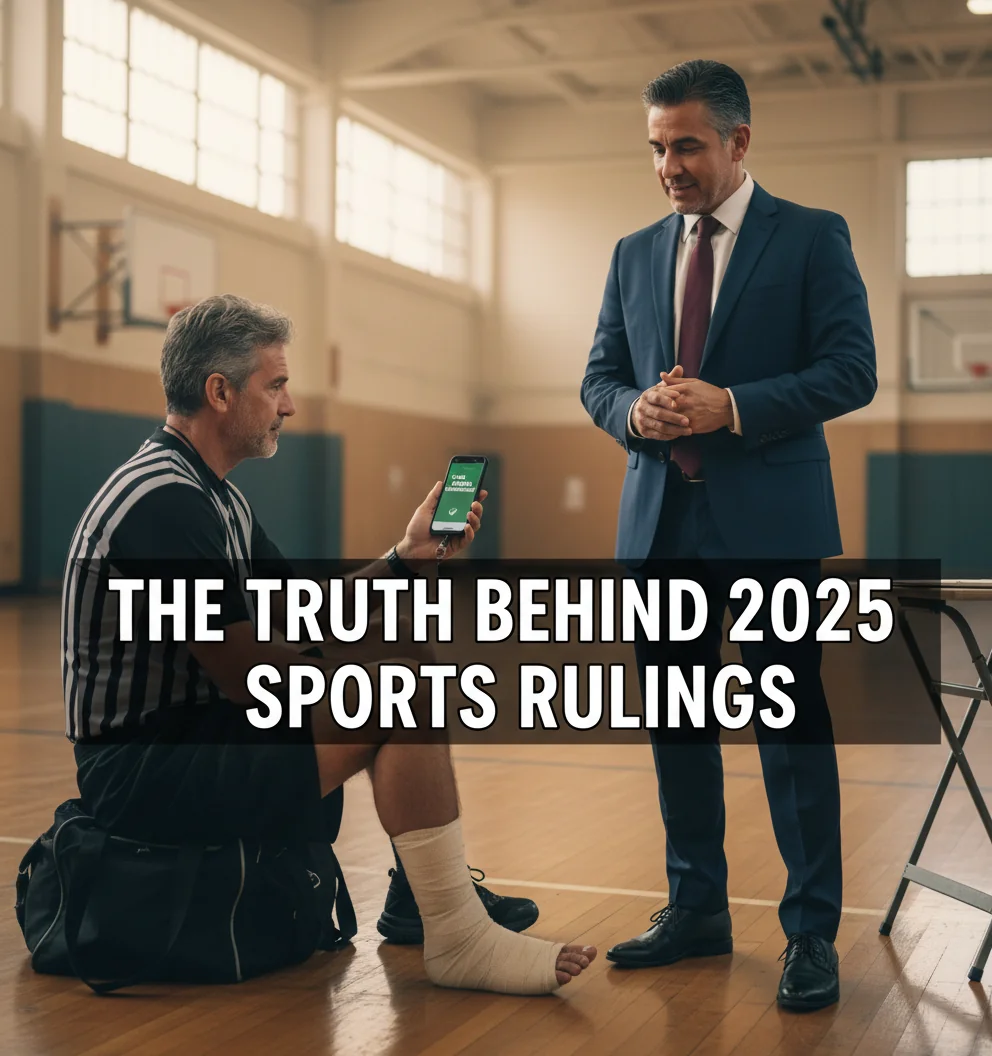
If you were hurt at work, the rules that decide whether you get paid can feel hidden. The same legal pressures shaping high-profile sports cases in 2025 also affect everyday workers’ comp claims—especially when insurers argue your injury “doesn’t count.” This article breaks down what a workers compensation lawyer NC looks for right away, using lessons pulled from the 2025 sports-law spotlight.
Quick Summary (Read This First)
What happened: 2025 sports-law cases highlighted how employment status, medical evidence, and deadlines can decide who pays for an injury.
Why it matters to you: Those same arguments show up in ordinary North Carolina workers’ comp claims—especially when insurers deny, delay, or downplay injuries.
What to do now: Report in writing, get medical care, and start building a clean paper trail before the insurer shapes the story.
What This News Means for North Carolina Residents
In 2025, sports-law disputes put workplace injury issues on a national stage—who counts as an “employee,” what medical proof is enough, and how contracts and policies can change outcomes. Even if you don’t work in sports, these themes matter because workers’ comp insurers use the same playbook: challenge the work connection, question medical causation, or argue you missed a rule.
That’s why the Law360 roundup of the court cases that defined sports law in 2025 is a useful lens. When big cases hinge on status and proof, smaller claims often see the same pressure—just with fewer headlines.
Why sports cases can predict workers’ comp fights
Sports employers, leagues, and insurers invest heavily in limiting exposure. That tends to generate arguments you also see in non-sports jobs:
- Employment status disputes: “Independent contractor” vs. “employee.”
- Scope of work disputes: “Off the clock” vs. “in the course of employment.”
- Medical causation disputes: Preexisting condition vs. work injury that aggravated it.
What this looks like for everyday workers in North Carolina
In North Carolina, common denial themes include: “You didn’t report on time,” “It happened outside work,” or “Your MRI doesn’t match your pain.” A workers compensation lawyer NC will usually focus on turning your story into provable facts: dates, witnesses, medical notes, and job duties.
Who decides disputes in North Carolina
When there’s a dispute, many cases end up in front of the North Carolina Industrial Commission, which oversees the workers’ compensation system and publishes rules and forms that can affect deadlines, filings, and hearing procedures.
What to Do in the Next 24-48 Hours
Think like the insurer will challenge you (because they might)
The first two days after an injury often decide what the records say forever. Your goal is simple: make the work connection clear and protect the medical story from getting distorted.
Fast action checklist you can follow
If this situation applies to you, take these steps NOW:
- Step 1: Document everything—photos, where it happened, who saw it, and a timeline you write while it’s fresh.
- Step 2: Report the injury to a supervisor in writing (text/email is fine) and keep a copy.
- Step 3: Get medical care and describe how the injury happened at work; ask the provider to note work restrictions clearly.
- Step 4: Consult with a legal expert to understand your rights and options
Two mistakes that can quietly damage your claim
- Vague reporting: Saying “my back hurts” without tying it to the work event can lead to a “not work-related” argument later.
- Gaps in treatment: Waiting weeks can give the insurer room to say something else caused it.
Warning Signs & Red Flags to Watch For
Patterns we see in disputed claims
These red flags often show up when a claim is headed toward a denial, suspension of checks, or a forced early return to work.
These are signs your case may be in jeopardy:
- Your employer pressures you to return to work before your doctor clears you (or offers “light duty” that still hurts you).
- The insurer delays payments, schedules repeated exams, or keeps asking for the same documents.
- You are told you “don’t qualify” because the injury is “preexisting,” “not reported,” or “not on the job.”
Seeing these signs? Vasquez Law Firm, PLLC has handled hundreds of denied claims in North Carolina. Attorney Vasquez knows the tactics insurers use. Get a free case evaluation.
Why these red flags matter (and why sports law is a clue)
In high-stakes sports disputes, parties fight hard over definitions, timelines, and medical proof. In a typical workplace injury case, the same strategy can show up in smaller ways—like narrowing what counts as “work-related,” or leaning on one doctor’s opinion to cut off benefits.
Your Rights: What You CAN and CANNOT Do
Rights that often protect injured workers
YOU HAVE THE RIGHT TO:
- Receive necessary medical treatment for a compensable injury (including specialist care when approved).
- Be paid wage-replacement benefits when you are taken out of work or restricted and you meet the rules.
- Challenge a denial and request a hearing through the North Carolina Industrial Commission process.
YOU CANNOT:

- Ignore reporting and filing deadlines—missing them can reduce or destroy benefits.
- Assume “light duty” is safe if it breaks medical restrictions—document and report problems immediately.
Vasquez Law Firm, PLLC helps North Carolina clients understand and protect their rights every day.
If you’re labeled a contractor, do you still have rights?
Sports cases often turn on status. In regular jobs, misclassification can be a big issue too. Whether you qualify for workers’ comp can depend on facts like who controls your schedule, tools, training, and whether you can refuse assignments. If you’re unsure, that’s exactly where a workers compensation lawyer NC focuses: the real relationship, not the label.
KEY TAKEAWAY:
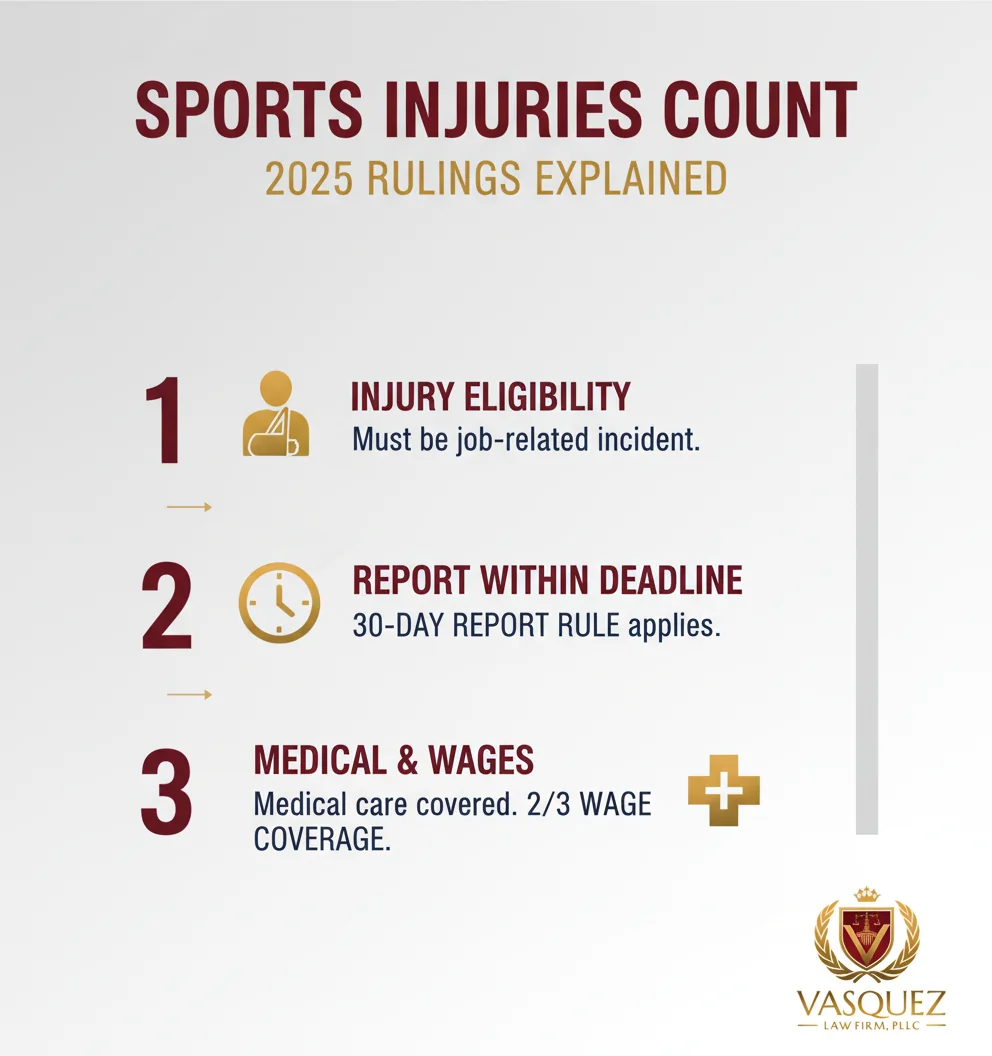
In North Carolina, you generally must give your employer written notice of a workplace injury within 30 days. Waiting can hand the insurer a denial argument—even if you were truly hurt on the job.
Documents You'll Need (Save This Checklist)
Why documents decide “he said / she said” battles
When a claim is disputed, the side with better records usually has the advantage. Your file should show: a clear work event, consistent symptoms, and consistent medical restrictions.
Gather these documents NOW (before they disappear):
- Any incident report you filed (or the message/email where you reported the injury).
- Medical records, work notes, prescriptions, and bills (even if insurance hasn’t paid yet).
- Photos of the injury and the area/equipment that caused it.
- Witness names and phone numbers (coworkers, customers, vendors).
- Pay stubs and your recent work schedule (to help prove average weekly wage and lost time).
Tip: Keep all documents organized in one folder - it makes the process much easier.
Extra proof that helps in “gray area” injuries
- Prior medical history: If you had an old injury, records can show you were stable before the work incident.
- Job description: Lifting requirements, repetitive motion duties, or safety rules can support causation.
- Communications log: Keep a simple dated list of calls and emails with HR, supervisors, and the adjuster.
KEY TAKEAWAY:
If the insurer sends you for an “independent medical exam,” treat it like a recorded event: be honest, be consistent, and write down what happened immediately after.
Legal Background and Context
The legal framework: North Carolina Workers’ Compensation Act
Most workplace injury claims in North Carolina are governed by the North Carolina Workers’ Compensation Act (commonly referenced as Chapter 97 of the North Carolina General Statutes). The system is administrative, meaning disputes typically go through the Industrial Commission rather than a standard civil lawsuit.
For official rules, forms, and system guidance, the NC Industrial Commission website is the best starting point. It also helps you confirm current forms and procedural updates.
Deadlines that matter (and why insurers focus on them)
In many disputed cases, the real fight is not only “were you hurt,” but “did you follow the steps the system requires.” Insurers often scrutinize:
- Notice: whether the employer received timely notice (often discussed as the 30-day notice rule).
- Medical causation: whether records tie symptoms to a work event or repetitive job duties.
- Disability proof: whether restrictions and wage loss align with benefit eligibility.
How 2025 sports law disputes connect to workers’ comp arguments
Sports disputes often spotlight how contracts, policies, and status labels can shape responsibility for injuries. That maps onto everyday claims when employers argue a worker was “off duty,” “not really an employee,” or injured during a personal task. A workers compensation lawyer NC will usually test those defenses against job realities: who controlled the work, what was required, and whether the injury arose out of and in the course of employment.
How Vasquez Law Firm, PLLC Helps North Carolina Clients Win These Cases
Why strategy matters more when the insurer says “no”
Denied and disputed claims are rarely fixed by one phone call. They are built (and won) through evidence: medical records, job duty proof, witness statements, and clear timelines. With 15 years of experience, Attorney Vasquez (admitted to the North Carolina State Bar and the Florida Bar) focuses on building the case the insurer can’t easily dismiss. Se Habla Español.
How we approach a disputed workers’ comp claim
Our experienced team, led by Attorney Vasquez, has helped hundreds of North Carolina clients. Here's exactly how we help:
- Step 1: We review the facts and identify the denial theme (status, notice, causation, disability).
- Step 2: We build the paper trail (medical support, wage proof, job duties, witness statements).
- Step 3: We address insurer tactics early (recorded statements, IMEs, surveillance concerns).
- Step 4: We prepare for hearing strategy when needed—so the case is organized and consistent.
Real example from our practice
Real example: "We recently helped a Charlotte construction worker whose claim was denied. Insurance said his injury 'wasn't work-related.' We gathered evidence, fought the denial, and won him $45,000 in benefits plus ongoing medical care." - Attorney Vasquez
If you’re searching for a workers compensation lawyer NC, it’s often because something already feels off—delays, mixed messages, or pressure to return too soon. Those issues are fixable when handled early and documented correctly.

Frequently Asked Questions (Specific to This Situation)
1) If I work for a sports team or gym in NC, am I treated differently in workers’ comp?
Often, the same Chapter 97 rules apply, but disputes can be more intense about status (employee vs. contractor) and “course of employment.” The 2025 sports-law cases highlight how much these labels and contracts can matter, so your job reality and records become critical.
2) My employer says I’m a 1099 contractor—does that automatically block workers’ comp in North Carolina?
No. A label does not always decide the outcome. Decision-makers look at control and work realities (who directs the work, supplies tools, sets hours, and can fire you). Status fights are a major theme in sports-related disputes and show up in regular workplaces too.
3) The adjuster said my injury is “preexisting,” like many sports injury cases—can my claim still be valid?
Yes. A work injury can aggravate an earlier condition. The key is medical documentation showing a change after the work event (new limitations, new imaging findings, increased treatment, or new restrictions). Consistent treatment and a clear timeline help.
4) The insurer scheduled an “independent medical exam.” Is this like the expert battles in high-profile sports cases?
In a practical way, yes—one medical opinion can be used to support a denial or cutoff. Bring accuracy and consistency: explain job duties, describe symptoms clearly, and document what happens. If the IME report conflicts with your treating records, that conflict may be contested.
5) I’m being told to return to work with restrictions, similar to “return-to-play” pressure in sports—what should I do?
Take restrictions seriously and keep everything in writing. If the offered job tasks exceed your restrictions, document the mismatch and report it. Returning too early can worsen injuries and complicate the benefit record.
6) I didn’t report my injury the same day—did I ruin my claim?
Not necessarily, but delay gives the insurer arguments. In North Carolina, notice issues are common in denials. Write down the date of injury, when you first reported it, and why there was a delay (fear of retaliation, didn’t realize seriousness, etc.), then gather witness and medical support.
7) If my claim is denied, where is it decided in North Carolina?
Disputes typically go through the North Carolina Industrial Commission process, which may involve filings, mediation, and hearings. Many contested claims turn on credibility and documents, so organizing records early can make a major difference.
Don't Navigate This Alone
If you're dealing with a denied or delayed workers’ compensation claim in North Carolina, Vasquez Law Firm, PLLC can help. With 15+ years serving North Carolina, we know what works.
Free consultation. Bilingual team. No fees unless we win.
Call Now: 1-844-967-3536
Se Habla Español - Hablamos Su Idioma
Free Legal Consultation
Discuss your case with our experienced attorneys. We're available 24/7.
Vasquez Law Firm
Legal Team
Our experienced attorneys at Vasquez Law Firm have been serving clients in North Carolina and Florida for over 20 years. We specialize in immigration, personal injury, criminal defense, workers compensation, and family law.