workers compensation lawyer NC: WARNING—2025 rulings change claims
workers compensation lawyer NC: WARNING—2025 court rulings may shift how claims get denied. Learn what to do now and protect benefits. Se Habla Español.
Vasquez Law Firm
Published on December 22, 2025

workers compensation lawyer NC: WARNING—2025 rulings change claims
If you were hurt at work, the rules can feel clear—until courts start changing how those rules get applied. The headline about Michigan’s 5 biggest court rulings of 2025 is a reminder that employers and insurance carriers adjust fast, and injured workers often learn about “new standards” only after a denial letter arrives. This article explains what a workers compensation lawyer NC looks for when rulings reshape arguments about notice, medical proof, and what counts as a work injury—so you can protect your claim in North Carolina before it gets boxed in.
Quick Summary (Read This First)
What happened: A roundup of major 2025 employment-related rulings highlights how courts can tighten or expand how workplace claims are evaluated.
Why it matters to you: Even though the article focuses on Michigan, insurers everywhere watch these trends and may copy arguments that lead to more denials, delays, and “prove it” demands—especially in workers’ comp.
What to do now: Document the injury, report it in writing, follow medical restrictions, and track every missed day of work so your evidence is ready if the carrier challenges the claim.
What This News Means for North Carolina Residents
Legal headlines can feel far away when you’re trying to heal. But big rulings often change how insurance companies argue cases in other states—because carriers, defense firms, and risk managers share playbooks nationwide.
That’s why the Law360 roundup on Michigan’s 5 Biggest Court Rulings Of 2025 matters. Even if you live and work in North Carolina, trends in employment decisions can influence how carriers push back on:
- Causation: “Was it really work-related, or just a preexisting problem?”
- Medical proof: “Show objective findings, not just pain complaints.”
- Scope of benefits: “You can work light duty, so wage checks should stop.”
- Procedural defenses: “You didn’t report it the right way or on time.”
Why out-of-state rulings can still affect your claim
North Carolina workers’ compensation is governed by state law and the North Carolina Industrial Commission. But carriers operate in multiple states and often test arguments that worked elsewhere. If a court decision supports a tougher standard for proof, you may see that language show up in denial letters and settlement negotiations.
What insurers tend to do after big rulings
After major rulings, carriers often become more aggressive about recorded statements, “independent” medical exams, and surveillance. None of that means your claim is weak. It means you should treat your claim like a file that may be judged later by a deputy commissioner—because it might.
North Carolina pressure points that get targeted
In North Carolina, two pressure points show up again and again: (1) whether the employer got proper notice, and (2) whether medical records clearly connect the condition to work. A workers compensation lawyer NC will usually focus early on those two issues because they are common denial hooks.
What to Do in the Next 24-48 Hours
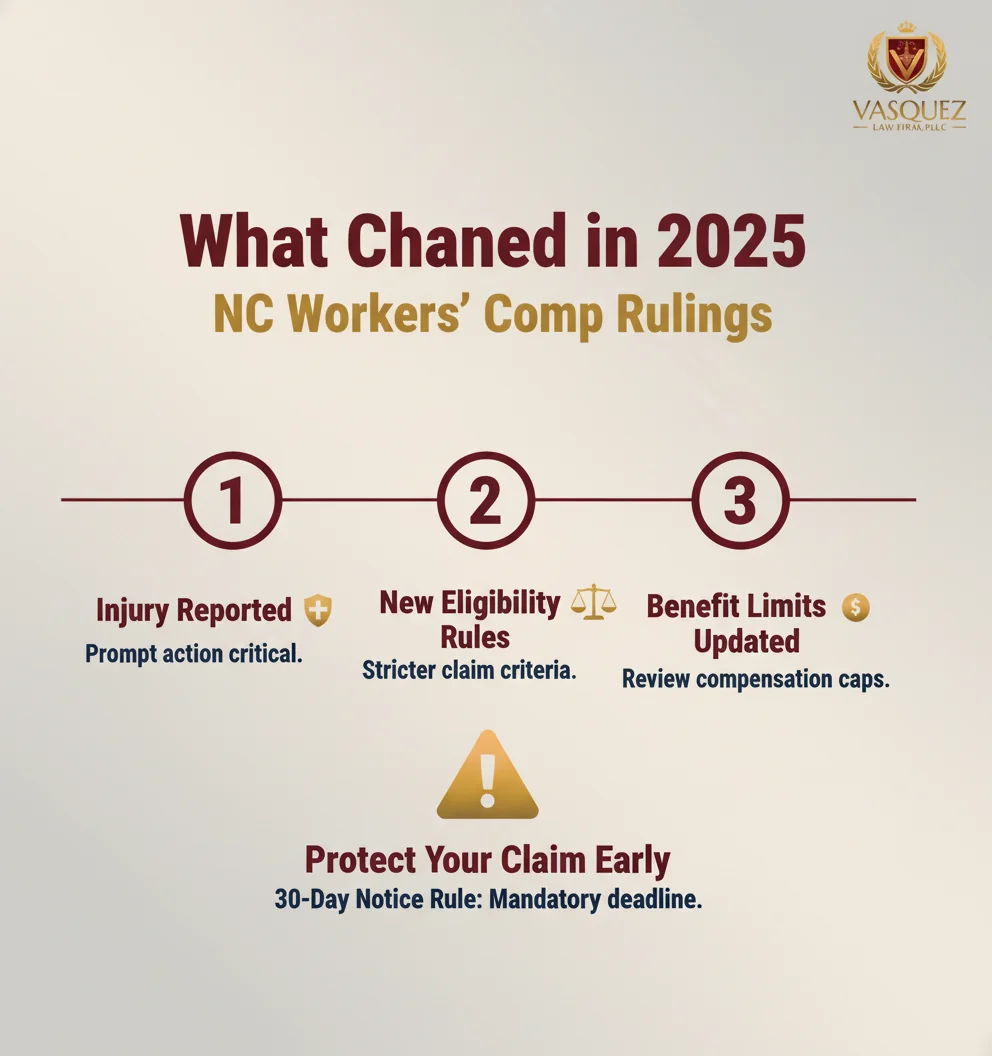
The first two days after a work injury often decide how hard the rest of the case becomes. If you assume “they’ll handle it,” you may lose key evidence without realizing it.
1) Make the report and create a paper trail
Report the injury to your supervisor as soon as possible, then follow up in writing (email or text is fine). If the injury built up over time, report when you first realized it was connected to work or when symptoms forced you to stop working.
2) Get medical care and be consistent
Tell the medical provider exactly how the injury happened at work. Small gaps—like “my back just started hurting” instead of “I lifted a 70-pound box and felt a pop”—get used later to argue the injury is not work-related.
3) Track work restrictions, missed time, and job duty changes
Write down every date you miss work, every duty you can’t do, and every time you’re offered “light duty.” These details matter when deciding wage benefits and whether the job offer is suitable.
If this situation applies to you, take these steps NOW:
- Step 1: Document everything—photos, incident location, names of witnesses, and a short timeline of symptoms.
- Step 2: Report the injury to your employer in writing and keep a copy (email screenshot or printed copy).
- Step 3: Do NOT guess or downplay symptoms in medical visits; be accurate and consistent.
- Step 4: Consult with a legal expert to understand your rights and options
Warning Signs & Red Flags to Watch For
When courts issue decisions that tighten standards (even in other states), insurers often respond by pushing harder on the “weak points” of a file. These red flags are common in North Carolina workers’ comp and often show up right before a denial or benefit cut-off.
Red flags involving benefits and medical treatment
These are signs your case may be in jeopardy:
- Your employer is pressuring you to return to work before the doctor clears you (or before restrictions are in writing).
- The insurance carrier delays authorizing appointments, therapy, MRIs, or specialist referrals without clear reasons.
- You’re told you “don’t qualify” because the injury was not witnessed, happened slowly over time, or involved a preexisting condition.
Seeing these signs? Vasquez Law Firm, PLLC has handled hundreds of denied claims in North Carolina. Attorney Vasquez knows the tactics insurers use. Get a free case evaluation.
Red flags involving paperwork and statements
Be cautious if you are asked to give a recorded statement right away or sign broad medical releases. You can cooperate while still protecting your privacy and making sure the facts are accurate.
Red flags involving light duty and job offers
A “light duty” offer can be legitimate—but it can also be used to cut wage checks even if the job is not suitable for your restrictions. If duties change day-to-day or you’re doing tasks outside restrictions, document it.

Your Rights: What You CAN and CANNOT Do
Workers’ compensation is a benefits system with strict rules. You have important rights, but you also have responsibilities. Understanding both helps avoid mistakes that insurers later label as “noncompliance.”
Rights related to medical care and wage benefits
YOU HAVE THE RIGHT TO:
- Receive medical treatment that is reasonably required to cure, give relief, or lessen the period of disability (often litigated in practice).
- Dispute a denial or benefit reduction and request a hearing at the North Carolina Industrial Commission.
- Have an attorney present before you agree to a settlement (often called a “clincher”).
YOU CANNOT:
- Ignore work restrictions and then expect the insurer to keep paying if you worsen your condition doing prohibited tasks.
- Miss key deadlines—late notice or late filings can reduce or eliminate benefits under North Carolina law.
Vasquez Law Firm, PLLC helps North Carolina clients understand and protect their rights every day.
Why court trends affect “what’s fair” in real life
Even when the law hasn’t changed in North Carolina, court decisions can change how “close calls” are evaluated—like whether medical notes are strong enough, whether work was a significant contributing factor, or whether a job offer is truly suitable.
Documents You'll Need (Save This Checklist)
When insurers tighten their review, documentation becomes leverage. The goal is simple: make it easy for a judge to see (1) you were hurt at work, (2) you reported it, (3) your medical care matches the event, and (4) your wage loss is real.
Workplace and incident proof
Medical proof
Wage and job duty proof
Gather these documents NOW (before they disappear):
- Any incident report, supervisor notes, or internal safety report.
- All medical records, work notes, restrictions, referrals, and bills (even if the carrier says it will “handle it”).
- Photos of the work area, equipment involved, and visible injuries (if applicable).
- Witness names, phone numbers, and short written statements if they are willing.
- Pay stubs and your recent wage history (to confirm average weekly wage and lost income).
Tip: Keep all documents organized in one folder - it makes the process much easier.
KEY TAKEAWAY:
In North Carolina, delays and denials often start with “missing proof”—not because the injury didn’t happen, but because the file lacks clear written notice, consistent medical history, and wage documentation.
Legal Background and Context
North Carolina workers’ compensation claims are administered through the North Carolina Industrial Commission. The basic framework is in Chapter 97 of the North Carolina General Statutes.
Notice and filing deadlines (where cases often get attacked)
Two rules come up constantly in contested cases:
- Notice: Under N.C. Gen. Stat. § 97-22, workers should give notice to the employer. Late notice can create disputes about whether the employer was prejudiced.
- Time limits: Under N.C. Gen. Stat. § 97-24, there are strict limitations periods tied to filing and payment of benefits. Missing these deadlines can end a claim.
Core benefits: medical care and wage replacement
Two common wage benefits are:
- Temporary total disability (TTD): Generally tied to being out of work due to the injury (see N.C. Gen. Stat. § 97-29).
- Temporary partial disability (TPD): When you return to lower-paying work because of restrictions (see N.C. Gen. Stat. § 97-30).
Why the 2025 ruling trend raises the stakes
When courts (even in other jurisdictions) emphasize stricter proof standards, carriers often respond by demanding:
- More detailed medical causation language in records
- More documentation of job duties and restrictions
- More reasons to dispute disability status or cut off checks
That is when many people search for a workers compensation lawyer NC—not because they want conflict, but because the system starts treating the case like a trial file.
How Vasquez Law Firm, PLLC Helps North Carolina Clients Win These Cases
Our experienced team, led by Attorney Vasquez, has helped hundreds of North Carolina clients. Here's exactly how we help:
We build the record insurers rely on (or fight against)
In a contested claim, the decision maker can only rule based on evidence. We focus on making sure your work injury story, your medical notes, and your wage loss proof all match.
We handle Industrial Commission procedure and deadlines
The Industrial Commission process can be unforgiving. A missed form, a late response, or a vague medical record can cost real money. A workers compensation lawyer NC helps keep the file tight and deadline-driven.
We push back on common carrier tactics
That includes benefit cutoffs, light-duty disputes, delayed treatment authorizations, and attempts to label symptoms as “unrelated.” If a carrier leans on arguments inspired by new rulings, we address the issue directly with evidence and legal briefing.
- Step 1: We review your case for free and tell you honestly if you have a claim
- Step 2: We handle all paperwork and deadlines so nothing gets missed
- Step 3: We fight insurance tactics - we know their playbook
- Step 4: We maximize your settlement or take it to hearing if needed
Real example: "We recently helped a Charlotte construction worker whose claim was denied. Insurance said his injury 'wasn't work-related.' We gathered evidence, fought the denial, and won him $45,000 in benefits plus ongoing medical care." - Attorney Vasquez

Vasquez Law Firm, PLLC is led by Attorney Vasquez, JD (15 years of experience), admitted to the North Carolina State Bar and Florida Bar. We serve injured workers across the state, and our team is bilingual—Se Habla Español.
Frequently Asked Questions (Specific to This Situation)
How the “2025 rulings” trend can show up in a North Carolina workers’ comp file
Below are questions we hear when people read about major employment rulings and worry that insurers will become stricter overnight.
1) If courts in Michigan tightened standards in 2025, can my North Carolina insurer use that to deny my claim?
They can’t change North Carolina law using an out-of-state case. But insurers may still copy the arguments—for example, demanding more detailed medical causation language or pointing to “objective findings.” The safest approach is to make your medical documentation clear and consistent and ensure your injury report is in writing.
2) After these 2025 court rulings, should I expect more requests for recorded statements in North Carolina?
Possibly. When carriers get more defensive, they often seek early recorded statements to lock in details. If you do provide one, accuracy matters more than speed. Do not guess about dates, weights, or prior symptoms. If you don’t know, say you don’t know.
3) My injury is repetitive stress (carpal tunnel/back strain). Are those more vulnerable when courts focus on proof?
Yes, repetitive trauma claims often get challenged because there isn’t one “accident moment.” In North Carolina, the key is detailed job-duty descriptions, consistent symptom history, and medical records that connect the condition to work activities. These cases can still be strong, but they require careful documentation.
4) If my employer says my injury is “preexisting,” does that mean workers’ comp is over?
No. A preexisting condition does not automatically defeat a claim. The real question is whether work caused, contributed to, or aggravated the condition in a compensable way. Medical records and the timing of symptoms are usually decisive.
5) Can my benefits stop if I’m offered light duty right after I report the injury?
Benefits can change depending on restrictions, wages, and whether the offered job is suitable. If you accept light duty, track the tasks you actually do and keep copies of written restrictions. If the job exceeds restrictions or your pay drops, those facts matter for benefit disputes.
6) Does it matter if my claim is in Charlotte vs. Raleigh when insurers get stricter?
The legal standard is statewide, but the practical experience can differ by employer policies, local provider networks, and how quickly evidence is collected. Hearings are handled through the North Carolina Industrial Commission, so consistency and documentation still control the outcome regardless of city.
7) If my claim is denied after these “new tougher arguments,” what is the next step in North Carolina?
A denial is not the end. The next step is usually to gather missing proof (medical causation, wage records, witness info) and pursue the dispute process through the Industrial Commission. Many denials turn on correctable documentation gaps.
Don't Navigate This Alone
If you're dealing with a denied or delayed workers’ compensation claim after insurers tighten their standards, Vasquez Law Firm, PLLC can help. With 15+ years serving North Carolina, we know what works.
Free consultation. Bilingual team. No fees unless we win.
Call Now: 1-844-967-3536
Se Habla Español - Hablamos Su Idioma
Free Legal Consultation
Discuss your case with our experienced attorneys. We're available 24/7.
Vasquez Law Firm
Legal Team
Our experienced attorneys at Vasquez Law Firm have been serving clients in North Carolina and Florida for over 20 years. We specialize in immigration, personal injury, criminal defense, workers compensation, and family law.