workers compensation lawyer NC: The Truth in 2025 Rulings
workers compensation lawyer NC: 2025 rulings show how insurers deny claims. Learn deadlines & next steps—get a free case review from Vasquez Law Firm, PLLC.
Vasquez Law Firm
Published on December 24, 2025
workers compensation lawyer NC: The Truth in 2025 Rulings
If you’re searching for a workers compensation lawyer NC, here’s the real issue many injured workers miss: the biggest fights aren’t only about the injury—they’re about proof, deadlines, and how insurers use court decisions to tighten denials. A recent roundup of Top Illinois Decisions of 2025 is a reminder that workers’ comp law is moving fast, and the arguments insurers test in one state often show up in another.
Quick Summary (Read This First)
What happened: A 2025 legal roundup highlighted major workers’ compensation and employment decisions in Illinois that insurers often use as “playbook” ideas nationwide.
Why it matters to you: Even in North Carolina, adjusters and defense lawyers watch these trends—especially around medical proof, causation, and return-to-work disputes.
What to do now: Report injuries in writing, lock down medical documentation, and track every missed day of work so your claim doesn’t get reframed later.
What This News Means for North Carolina Residents
Legal “trend” articles can sound far away—Illinois isn’t North Carolina. But the practical impact is close to home. When national outlets highlight major decisions, insurance carriers and third-party administrators often use the same arguments across states. That’s why the Top Illinois Decisions of 2025 roundup matters to workers here: it signals what issues insurers are focusing on right now—medical causation, work restrictions, surveillance, and what counts as a valid reason to deny benefits.
Why an Illinois ruling trend can show up in NC claims
Workers’ compensation is state-based, but insurance strategy is not. Large carriers operate in many states. When they see a defense theory succeed somewhere else, they often test it again—especially in borderline cases like repetitive trauma (back/shoulder), aggravations of old injuries, and disputes over “maximum medical improvement” (MMI).
How North Carolina’s workers’ comp system decides your case
In North Carolina, workers’ compensation disputes are handled through the North Carolina Industrial Commission (the “Commission”), not a typical civil lawsuit court. Your benefits depend heavily on timely notice, credible medical opinions, and whether the insurer accepts or denies the claim.
The practical “2025 takeaway” for NC injured workers
The takeaway is simple: documentation wins cases. If your file is thin early on, an insurer may later argue that your injury is not work-related, that you could return sooner, or that you refused suitable work. That is exactly the kind of playbook tightening that tends to follow widely discussed decisions.
What to Do in the Next 24-48 Hours
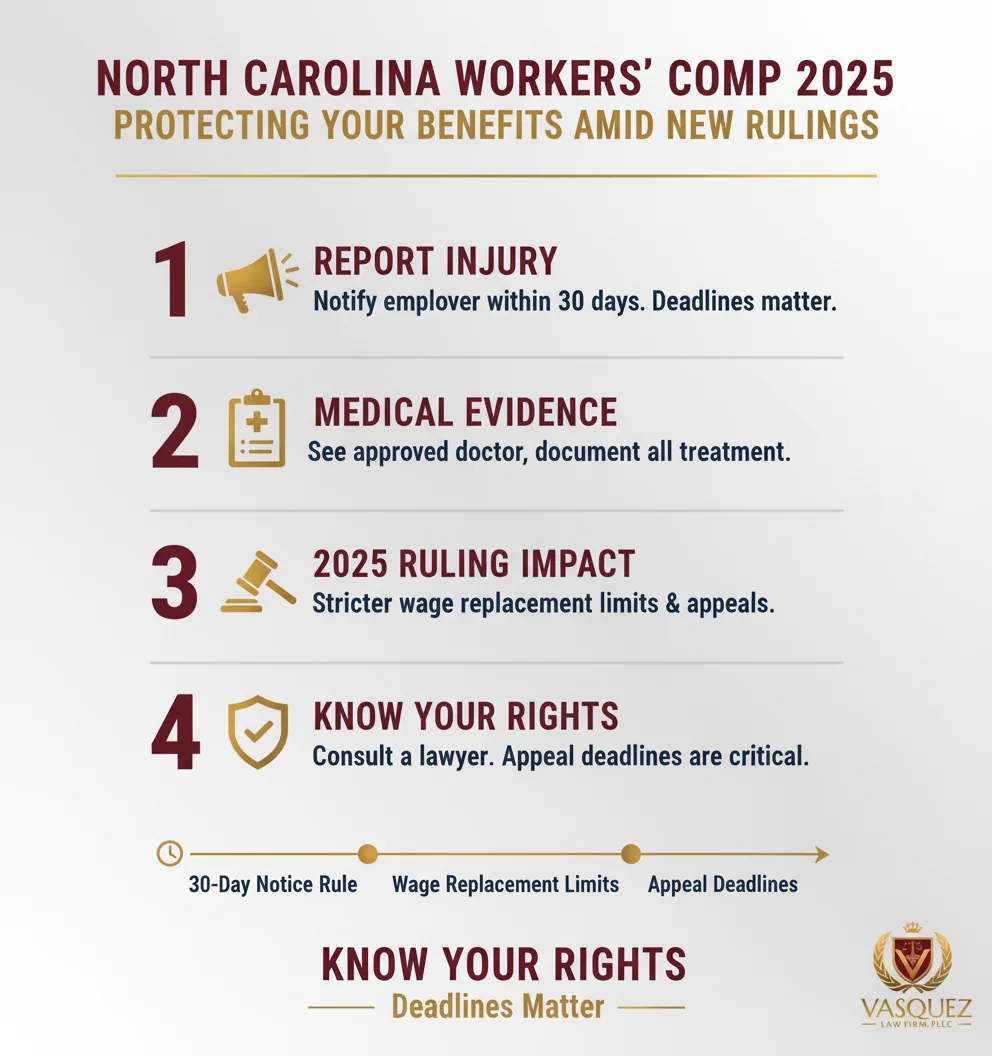
If this situation applies to you, take these steps NOW:
- Step 1: Document everything—take photos, save texts/emails, write down the time, place, witnesses, and what task you were doing when you got hurt.
- Step 2: Report the injury in writing to your supervisor/HR as soon as possible (do not rely on a verbal report alone).
- Step 3: Get medical care and clearly tell the provider it is a work injury; ask them to note work restrictions in the chart.
- Step 4: Do NOT sign broad medical releases, recorded statements, or “light duty” forms you don’t understand—save them for review.
KEY TAKEAWAY:
In NC, waiting too long to give notice can be fatal to a claim. North Carolina law generally requires notice to the employer within 30 days of the accident/injury (with limited exceptions). Put it in writing and keep a copy.
Warning Signs & Red Flags to Watch For
These are signs your case may be in jeopardy:
- Your employer is pressuring you to return before your doctor clears you or is ignoring written restrictions.
- The insurer says “we’re investigating” but delays authorizing treatment, therapy, MRI, or specialist referrals.
- You’re told you “didn’t report it right,” “it’s pre-existing,” or “it happened at home”—even though it happened at work.
Seeing these signs? Vasquez Law Firm, PLLC has handled hundreds of denied claims in North Carolina. Attorney Vasquez knows the tactics insurers use. Get a free case evaluation.
Your Rights: What You CAN and CANNOT Do
YOU HAVE THE RIGHT TO:
- Receive medical treatment that is reasonably required to cure, provide relief, or lessen the period of disability (when authorized under NC workers’ comp rules).
- Be paid wage replacement if you are taken out of work or limited and meet eligibility requirements (often called TTD/TPD benefits).
- Request a hearing at the North Carolina Industrial Commission if your claim is denied or benefits are cut off.
YOU CANNOT:
- Ignore work restrictions or skip appointments and expect benefits to continue—insurers often use gaps in care to argue you recovered.
- Miss strict notice and filing deadlines—late action can limit or eliminate benefits.
Vasquez Law Firm, PLLC helps North Carolina clients understand and protect their rights every day.

Documents You'll Need (Save This Checklist)
Gather these documents NOW (before they disappear):
- Any written injury report to your employer (email to HR, incident form, supervisor text).
- Medical records, work notes/restrictions, prescriptions, and discharge paperwork from urgent care/ER.
- Photos/video of the hazard, equipment, or scene (and visible injuries, if appropriate).
- Witness names and contact info (coworkers, subcontractors, customers).
- Your pay stubs (to prove your average weekly wage and lost time).
Tip: Keep all documents organized in one folder—it makes the process much easier.
KEY TAKEAWAY:
A strong file is built early. If the first medical notes don’t mention “work injury,” insurers may argue later that it was not job-related—especially after you return to work or symptoms worsen.
Legal Background and Context
North Carolina workers’ compensation is governed mainly by the North Carolina Workers’ Compensation Act (Chapter 97 of the General Statutes). Two deadlines matter in almost every dispute:
- Notice to employer: North Carolina law generally requires an employee to give notice within 30 days of the accident/injury (with limited exceptions). See N.C. Gen. Stat. § 97-22.
- Filing with the Commission: Many claims require filing the proper form(s) to protect benefits. Workers often hear about “Form 18” because it is the common form used to notify the Commission of an injury.
Common forms and why insurers care about them
The Commission publishes forms and guidance at the NC Industrial Commission website. In day-to-day practice, disputes often turn on whether the claim was properly opened, whether the insurer accepted liability, and whether benefits were properly stopped.
Medical causation: the fight behind most denials
Many denials are not “you weren’t hurt.” They are “you can’t prove it’s related to work.” This is where national trends (like those discussed in 2025 legal coverage) can matter: insurers push for narrow readings of causation, emphasize pre-existing conditions, and look for inconsistencies in early records.
Return-to-work disputes and wage benefits
If your doctor gives restrictions, the employer may offer “light duty.” If it is suitable and within restrictions, refusing it can put wage checks at risk. If it is not suitable (too heavy, wrong schedule, too far, or not actually within restrictions), you may need evidence to prove that.
KEY TAKEAWAY:
A workers compensation lawyer NC focuses on what insurers focus on: deadlines, medical proof, and wage documentation. The sooner you treat your case like a “paper trail” problem, the harder it is to deny.
How Vasquez Law Firm, PLLC Helps North Carolina Clients Win These Cases
When you hire a workers compensation lawyer NC, you want more than form-filing. You want someone who understands how the insurer builds a denial and how to dismantle it with evidence. Vasquez Law Firm, PLLC is led by Attorney Vasquez, JD, who has 15 years of experience and is admitted to the North Carolina State Bar and the Florida Bar. Se Habla Español.
What we do that moves the needle
Our approach is evidence-first. We focus on turning a confusing claim into a clear timeline supported by records that the Commission expects to see.
- Step 1: We map the facts (injury mechanism, witnesses, job duties, prior history) and identify the weak points insurers usually attack.
- Step 2: We organize the medical story (work restrictions, referrals, imaging, MMI opinions) so your case matches what decision-makers look for.
- Step 3: We manage Commission communications and deadlines and address denial language head-on.
- Step 4: We pursue the right benefit path (medical care, wage benefits, settlement options) and prepare for hearing when necessary.
Serving workers across North Carolina
Work injuries happen everywhere—construction sites near Uptown Charlotte, warehouses along I-40 corridors, and job sites that feed into Raleigh and other growing areas. If your dispute heads toward litigation, hearings are handled through the North Carolina Industrial Commission (headquarters in Raleigh), and evidence quality matters.
Real example (results depend on facts)
Real example: “We recently helped a Charlotte construction worker whose claim was denied. Insurance said his injury ‘wasn’t work-related.’ We gathered evidence, fought the denial, and won him $45,000 in benefits plus ongoing medical care.” — Attorney Vasquez
To learn more about the process and what benefits may be available, see our Workers Compensation services page.
Frequently Asked Questions (Specific to This Situation)
1) Do the “Top Illinois Decisions of 2025” change North Carolina workers’ comp law?
No. Illinois decisions are not binding in North Carolina. But the strategies and themes highlighted in big legal roundups can influence how insurers argue cases here—especially on medical causation, work restrictions, and what evidence is “enough.” That is why a workers compensation lawyer NC will often prepare for the same kinds of arguments even when the cases are out of state.

2) Can an NC insurer deny my claim by citing an out-of-state case?
They can cite anything in a denial letter, but the North Carolina Industrial Commission applies North Carolina law. Out-of-state decisions may be used as persuasive talking points, not controlling authority. What usually matters more is whether your medical records and witness evidence support that the injury arose out of and in the course of employment under NC standards.
3) If my adjuster says “we’re following new 2025 standards,” is that real?
Be careful with that phrasing. North Carolina benefits are governed by Chapter 97 and Commission rules, not vague “new standards.” Sometimes adjusters use broad language to justify delays or tighter documentation requests. You can ask them to identify exactly what form, rule, or medical requirement they believe applies.
4) My doctor wrote “pain started weeks ago” instead of “hurt at work.” Can that sink my NC claim?
It can create problems, because insurers may argue the condition is not work-related. This is common in back/neck injuries, repetitive trauma, and conditions that worsen over time. Often, the issue is not fraud—it’s how the intake history was recorded. Correcting the record may require follow-up notes, a clarified history, and consistent reporting. A workers compensation lawyer NC will usually focus on cleaning up the timeline before it hardens into a denial narrative.
5) What if my employer offers “light duty” that ignores restrictions?
If the offered job is not truly within the doctor’s restrictions, accepting it can worsen your condition and create confusion in the record. But refusing without documentation can risk wage checks. A safer path is to get restrictions in writing, communicate concerns in writing, and ask the doctor to confirm what you can and cannot do. In disputed cases, Commission-level evidence is key.
6) I reported my injury late. Is my claim automatically dead in North Carolina?
Late notice can seriously harm a claim, but it is not always automatic. North Carolina law generally requires notice within 30 days, with limited exceptions. The facts matter: when you realized it was work-related, whether the employer had actual knowledge, and whether the delay prejudiced the employer. This is exactly the kind of issue where early legal analysis matters.
7) If my case goes to a hearing, what evidence matters most right now?
Three categories usually matter most: (1) consistent medical records tying the injury to work, (2) wage proof and disability documentation (work notes, restrictions, missed time), and (3) credible witness/job-duty evidence showing what happened and why the injury makes sense for your work. The “2025 trend” across jurisdictions is a heavier emphasis on documentation and credibility, so building the file early is critical.
Don't Navigate This Alone
If you're dealing with a denied, delayed, or underpaid North Carolina workers’ compensation claim, Vasquez Law Firm, PLLC can help. With 15+ years serving North Carolina, we know what works.
Free consultation. Bilingual team. No fees unless we win.
Call Now: 1-844-967-3536
Se Habla Español - Hablamos Su Idioma
Free Legal Consultation
Discuss your case with our experienced attorneys. We're available 24/7.
Vasquez Law Firm
Legal Team
Our experienced attorneys at Vasquez Law Firm have been serving clients in North Carolina and Florida for over 20 years. We specialize in immigration, personal injury, criminal defense, workers compensation, and family law.